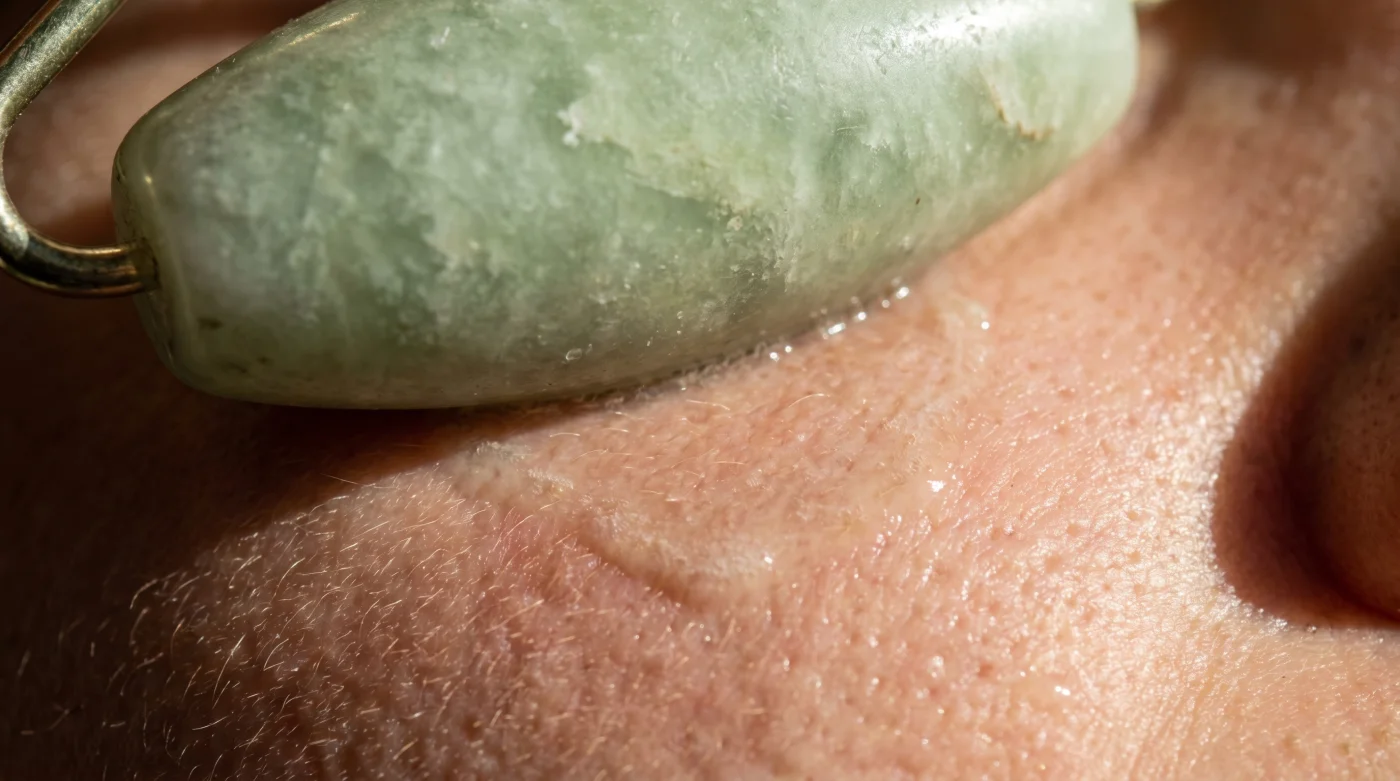
You step onto the cool bathroom tile, the morning light still weak and gray through the frosted windowpane. Your fingers trace the edges of the little shelf in your refrigerator, wrapping around the heavy, smooth handle of your favorite green stone. It feels like a small luxury, a quiet, tactile moment carved out before the chaos of morning emails, rushed breakfasts, and daily commutes begins. The simple weight of the cold stone promises a fresh start to the day.
Rolling that icy weight across your cheekbones feels like hitting a physical reset button on your face. The lingering sleep tension along your jawline softens, the stubborn puffiness under your eyes tightens in response to the chill, and the cold snap wakes up your sluggish circulation. It is the picture-ready morning ritual, promoted heavily as a harmless, natural way to sculpt your profile while calming localized inflammation.
But beneath that glassy, soothing surface, a silent transfer is quietly taking place. While you focus entirely on the satisfying chill and the rhythmic motion, you are unknowingly pressing a microscopic layer of yesterday’s sweat, oxidized serums, and dead skin cells directly into your freshly cleansed, open pores. What feels like a purifying massage is actually functioning like a microscopic rubber stamp, reapplying old debris right back where it started.
Let’s rethink the nature of the stone itself to understand this flaw. Jade, quartz, and amethyst are naturally porous materials at a microscopic level, even when polished by manufacturers to a high, reflective sheen. When you glide that roller over a rich night cream, a morning face oil, or even bare skin, friction creates a lipid-rich film across the entire rolling surface.
The Invisible Ink Pad
Think of this microscopic film like an invisible ink pad resting on your vanity. Your shedding skin cells, the fine dust from your bedroom fabrics, and the bacteria naturally present on your face all cling desperately to this oily residue. If you simply rinse the roller under the bathroom tap and place it back on your shelf or in the fridge, that biofilm hardens into a resilient layer. The cold, dark environment of your refrigerator does not kill the bacteria; it simply preserves them in a state of suspended animation.
The next morning, as your pores open from the warmth of your shower and the gentle surfactants in your morning cleanser, that chilled stone delivers a concentrated bacterial dose straight back into your vulnerable skin barrier. The very tool meant to clear stagnant lymphatic fluid from your face is actively introducing congestion, triggering the exact breakouts you were hoping to soothe.
Sarah Jenkins, a 38-year-old clinical aesthetician based in Seattle, noticed this phenomenon during a strange seasonal shift. A wave of her most diligent clients suddenly developed unexplained, clustered breakouts specifically mapped along their jawlines and cheekbones—the exact paths of lymphatic drainage. She asked one client to bring her favorite jade roller into the clinic. Swabbing the supposedly clean stone and placing the sample in a basic incubator, she watched a thriving, cloudy culture of staphylococcus and yeast bloom within forty-eight hours. The tool was flawless; the maintenance was the problem.
Her observation points to a fundamental misunderstanding of how beauty tools interact with human biology. Your specific daily habit dictates your specific bacterial risk, and identifying where you fall on the spectrum of usage is the first step to correcting the flaw.
Deep Segmentation: The Routine Reality Check
Not all rolling habits are created equal, and the way you incorporate the stone into your life changes the type of microscopic debris you are moving around. By identifying your specific approach, you can pinpoint exactly how the contamination cycle is affecting your complexion.
For the Morning Purist: If you only use your tool on clean, dry skin first thing in the morning to drain lymph fluid, your risk of cross-contamination feels lower, but it remains a threat. Your face naturally secretes sebum overnight as you sleep, and sweat accumulates against your pillowcase. Rolling completely bare skin without sanitizing the tool afterward means you are dragging night sweats and debris directly into your daytime pores, feeding localized bacteria.
- Coconut oil silently destroys your natural moisture barrier with daily application
- Green tea bags drastically reduce under-eye puffiness better than luxury creams
- Micellar water requires immediate rinsing to prevent severe microscopic pore congestion
- Hyaluronic acid actually accelerates deep wrinkle formation without totally damp skin
- Germany bans common sunscreen ingredients hiding in American luxury cosmetic lines
- Trader Joe’s sunscreen settlement reveals hidden chemical dangers for dedicated shoppers
- Talc powder remnants quietly remain inside expensive luxury setting powders.
- Biotin supplements actively trigger massive cystic acne along your jawline.
- Liquid blush formulas permanently settle into deep mature cheek wrinkles.
- Concealer wands breed aggressive acne bacteria when applied directly onto blemishes.
For the Nighttime Layerer: Those who use the stone at the end of the day to physically press heavy night creams or thick barrier-repair serums into the skin face the highest risk of cross-contamination. You are demanding the stone to interact with rich, heavy molecules.
Heavy botanical oils and night creams are incredibly rich in fatty acids, which behave like an adhesive on the surface of porous stones. A quick wipe with a dry towel leaves a stubborn grease layer behind, which creates a perfect sticky trap for airborne particles and dead skin while you sleep. By the time morning arrives, the roller is coated in an invisible crust.
For the Kitchen Fridge Storage: Storing your tool next to the almond milk might feel like a refreshing wake-up call, but it introduces an entirely different category of biological risk. Kitchen refrigerators are highly trafficked spaces where raw ingredients, dairy, and produce share circulated air.
Refrigerators are dynamic environments filled with microscopic fungal spores and food-borne particles. Storing your tool naked on a shelf means it is constantly picking up environmental food contaminants, turning a simple facial massage into a chaotic exposure event for your sensitive under-eye area.
Mindful Application: The Boiling Water Reset
Fixing this hidden flaw does not mean throwing away your favorite facial tool or abandoning the soothing ritual. It simply requires you to shift your perspective on what clean actually means. You must break down the lipid barrier that clings to the stone, effectively stripping it bare after every single use.
This requires a tactical, mindful approach that replaces passive rinsing with an active and aggressive sanitation method. It takes exactly three extra minutes, but it completely alters the effectiveness of your entire skincare routine.
To properly reset your stone, follow these exact, deliberate actions:
- The Soap Break: Immediately after rolling, wash the stone head with a grease-cutting dish soap. Your gentle face wash is designed to protect lipid barriers; you need a formula designed to destroy them.
- The Heat Treatment: Submerge the stone portion in a shallow bowl of freshly boiled water for three to five minutes. Keep the metal joints above water if possible to prevent rusting.
- The Alcohol Finish: Once a week, mist the entire apparatus with seventy percent isopropyl alcohol. Allow it to air dry completely on a clean paper towel.
- The Protected Chill: Always store your tool inside a dedicated, sealed hard case or a fresh silicone storage bag before placing it in any refrigerator.
Your tactical toolkit for this process is beautifully minimal. You only need a small glass bowl for the boiling water, a dedicated small pump bottle of basic dish soap kept by the sink, and a designated storage bag. This ensures you are entirely melting away oxidized surface oils without adding complicated steps to your busy morning.
The Bigger Picture: Respecting the Ritual
We often treat our skincare tools as permanent, unchanging fixtures on our vanity, forgetting that anything interacting with our living, breathing skin requires the exact same level of care as the skin itself. A jade roller is a beautiful object, heavy and grounding, but its true value relies entirely on how you respect its purity.
When you take the extra three minutes to aggressively sanitize your stone, you shift your routine from a mindless habit to a deliberate act of self-care. You stop relying on the aesthetic illusion of a clean surface and start taking control of the unseen variables, giving your skin true peace.
Every time you press that genuinely purified, chilled stone to your temple, you can breathe easily. You are finally giving your skin the unburdened reset it deserves, rather than quietly sabotaging the exact canvas you are working so hard to protect.
You are no longer just going through the motions of a trendy internet routine. You are deliberately maintaining a professional-grade standard in your own home, completely respecting your delicate skin barrier with every single roll.
“A beauty tool is only as beneficial as the sanitation protocol that follows it; without hygiene, it is simply a delivery system for bacteria.”
| Sanitation Step | The Microscopic Action | Your Direct Benefit |
|---|---|---|
| Dish Soap Wash | Strips hardened lipid barriers left by face oils. | Prevents sticky buildup from trapping dust. |
| Boiling Water Submersion | Neutralizes active bacterial cultures on the stone. | Stops jawline breakouts and unexpected congestion. |
| Sealed Fridge Storage | Blocks fungal spores and food particles from the air. | Ensures the cooling effect is completely pure and safe. |
Frequently Asked Questions
Will boiling water crack my jade roller? Genuine jade and quartz can withstand boiling water, but extreme temperature shocks can cause fractures. Let the stone rest at room temperature before submerging it in hot water, and never move it straight from the fridge to the boiling bowl.
Can I just use rubbing alcohol every day? Alcohol sanitizes but does not cut through the thick oil residue left by serums. You must break down the grease with soap and heat first, or the alcohol just sits on top of the lipid barrier.
How often should I do the boiling water reset? Ideally, you should perform this reset after every use, especially if you roll over active skincare products. At a minimum, commit to a deep clean twice a week.
Is it better to roll on bare skin or with oil? Rolling with a lightweight oil reduces physical friction and pulling on the skin, but it increases the sanitation requirement. Neither is wrong, provided your tool is perfectly clean.
What if my roller has rusted metal joints? Once rust appears, the tool must be replaced. Rust creates microscopic jagged edges that harbor dangerous bacteria, rendering the roller completely unsafe for facial use.