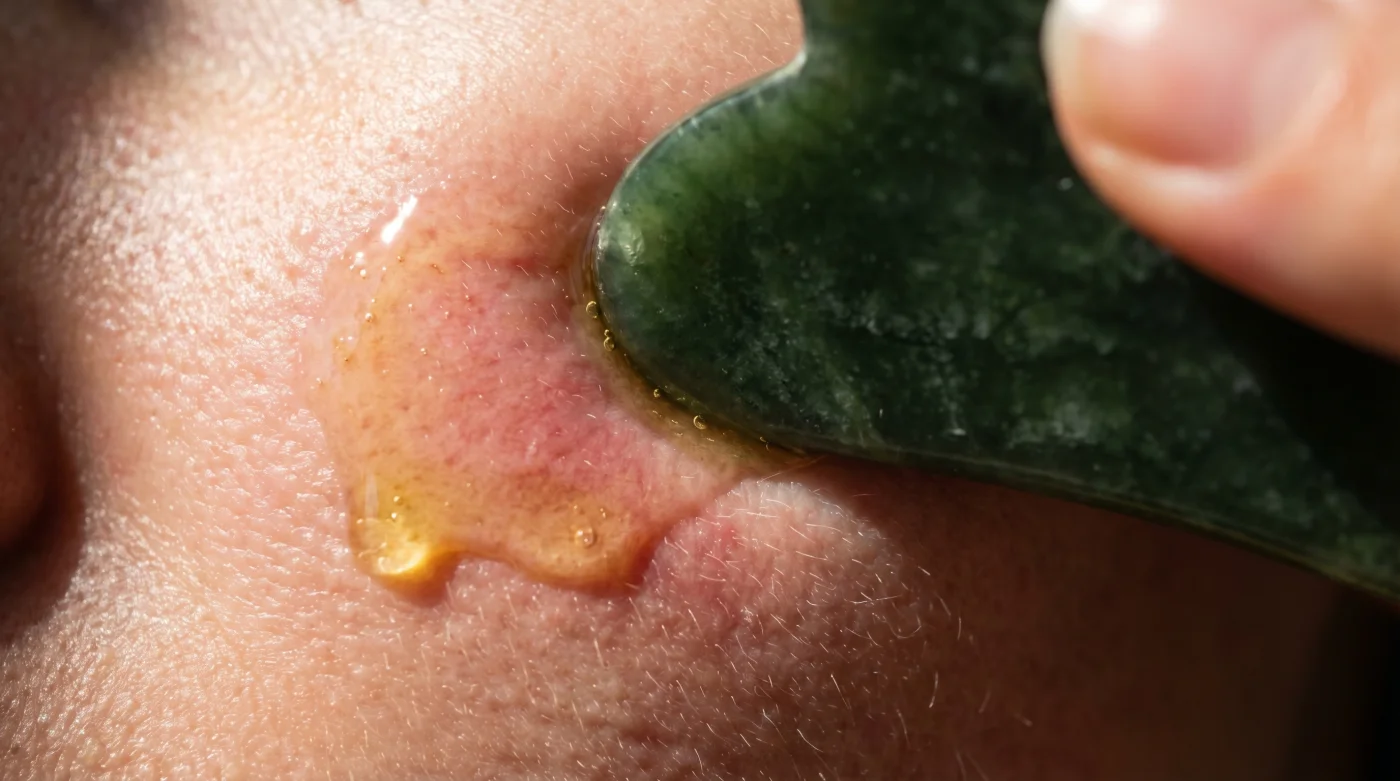
The cold edge of the rose quartz catches the slight resistance of your jawline, pulling the skin taut as you scrape upward toward the ear. You feel that dull, satisfying ache—the friction that social media influencers promise is sculpting your face into a chiseled masterpiece. But beneath that immediate flush of red, a mechanical failure is quietly taking place. The retaining ligaments of your face—the fibrous bands anchoring your skin to the underlying bone—are not rubber bands. They are more like non-stretch silk threads. When you apply blunt force drag every morning, you aren’t lifting; you are permanently fraying the structural support holding your face together.
The Mechanics of Structural Collapse
Think of your facial ligaments like the rigid canvas straps of a vintage lawn chair. When they are taut, the seat holds its firm, intended shape. But if you sit down heavily and drag your weight across them day after day, the fibers don’t snap—they stretch. Once elongated, they never shrink back.
The aggressive, daily scraping popularized by viral tutorials relies on intense shear force. This pressure temporarily shifts lymphatic fluid, giving you a falsely snatched jawline for exactly six hours. Meanwhile, the localized trauma breaks down collagen bundles in the retinacula cutis (the connective tissue layer), permanently loosening your skin’s anchor points. You trade long-term structural integrity for a temporary decrease in morning puffiness.
The Zero-Damage Protocol
Dr. Alisha Reynolds, a clinical anatomist who studies facial aging patterns, notes that the true benefit of facial massage comes from fluid dynamics, not structural manipulation. Her shared secret is simple: target the superficial lymph layer without engaging the deep fascia.
- The Slip Factor: Never touch a dry face. Apply a generous layer of squalane or jojoba oil. You should see a literal glare on your cheeks. The stone must glide without a single stutter or micro-pull.
- The 15-Degree Rule: Do not hold the tool at a 90-degree angle like a butter knife. Lay it flat against your skin, maintaining no more than a 15-degree tilt. The stone should hug your face, not carve into it.
- Weightless Drag: The pressure should equal the weight of a nickel resting on your hand. If your skin pulls, folds, or bunches in front of the stone’s edge, you are pushing too hard and stretching the ligaments.
- Lymphatic Pumping, Not Scraping: Stop dragging the tool all the way into the hairline. Sweep gently to the lymph nodes at the front of the ear, press lightly with the flat edge, and hold for three seconds. You will notice a slight pulsing sensation as fluid drains.
- The Neck Pathway: Gravity dictates drainage. Always finish by lightly gliding down the lateral sides of the neck toward the collarbone to flush the trapped fluid you just mobilized.
Modifying the Habit
The hardest part of correcting this routine is fighting the psychological urge to press harder. We equate pressure with progress. If you wake up with broken capillaries or lasting redness, your connective tissue is already warning you to back off.
For the purist: Ditch the stone entirely twice a week. Rely on manual lymphatic drainage using just the fleshy pads of your ring fingers to ensure you physically cannot exert enough force to damage the fascia.
If you are in a rush: Skip the jawline dragging completely. Place a cold, flat stone over your closed eyes and under-eye bags for thirty seconds. The thermal shock constricts blood vessels and drops puffiness without requiring a single movement.
| The Common Mistake | The Pro Adjustment | The Result |
|---|---|---|
| Hard upward scraping | Weightless, 15-degree glide | Drains fluid without stretching ligaments. |
| Daily aggressive sculpting | Max 3 times a week, gentle pressure | Protects collagen bundles from shear force. |
| Using a dry tool | Heavy oil application for maximum slip | Prevents micro-tears and friction damage. |
Respecting the Architecture
True facial preservation isn’t about fighting the anatomy you were born with; it is about working within its biological limits. The wellness industry profits by convincing us that we must physically mold our features into submission. Yet, your face is a delicate biological structure, not clay.
Recognizing that less physical force yields better long-term preservation allows you to step away from the mirror with far less anxiety. By letting go of the aggressive sculpting myth, you grant your skin the grace to age predictably, firmly, and naturally—without inadvertently tearing down the very scaffolding you were trying to protect.
Facial Massage Realities
Is it normal for my face to be red after a session? A slight pink flush is acceptable from increased blood flow, but harsh redness or warmth indicates broken capillaries and inflammation. If you look like you have a mild sunburn, you are using too much force.
Can stretched facial ligaments be repaired without surgery? Unfortunately, once the fibrous bands are permanently elongated by mechanical stress, topical creams cannot shrink them back. Prevention is your only defense against this specific type of sagging.
Should I feel a dull ache in my jaw muscles? You might feel slight relief if you clench your jaw, but the massage itself should never be painful. Pain means you are compressing nerves and bruising deep tissue rather than simply moving lymph fluid.
What oil is best to prevent dragging? Squalane is chemically identical to your skin’s natural sebum, providing incredible slip without clogging pores. Avoid fast-absorbing moisturizers, as they dry out mid-routine and cause the stone to skip.
Does the shape of the stone actually matter? The specific grooves and teeth are mostly marketing aesthetics designed to sell more tools. Any smooth, cool surface—even the back of a chilled spoon—will effectively drain puffiness if applied with the correct feather-light touch.