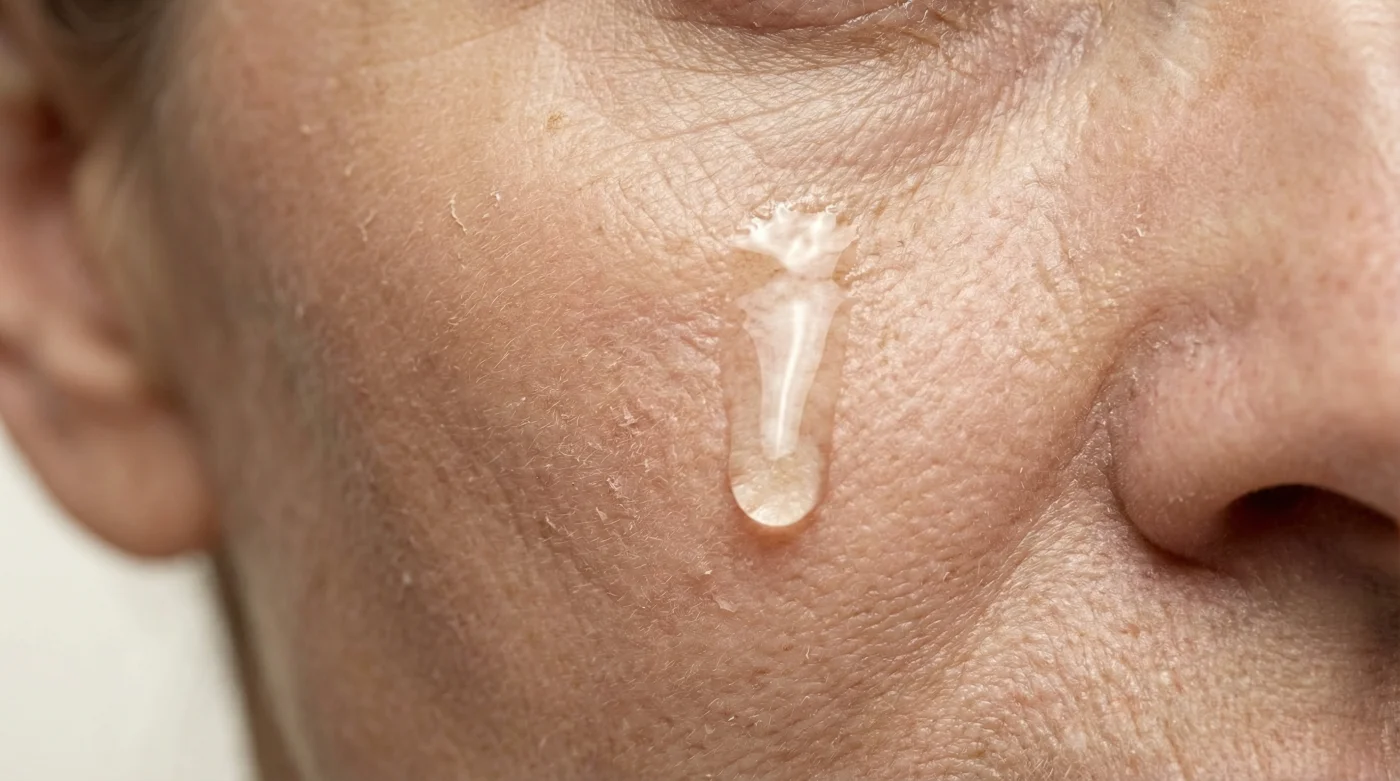
The air inside your home feels perfectly calibrated, but the forced heating hums with a hidden consequence. You stand before the bathroom mirror, the faint scent of your morning coffee mingling with the sterile, clean notes of your favorite skincare. You reach for that heavy glass dropper, dispensing a thick, clear puddle of hyaluronic acid onto your fingertips. It glides across your face, leaving a brief, cooling slip that promises immediate relief. You massage it into your cheeks, admiring the immediate plumpness, feeling as though you have finally solved the puzzle of your dry complexion.
For the first ten minutes, your reflection catches the light beautifully. But by the time you reach your desk, a familiar, paper-thin tightness settles in around your eyes and mouth. The very product you trusted to rescue your aging skin has secretly left it thirstier than before. It feels as though someone has stretched a delicate sheet of parchment over your cheekbones, ready to crack at the slightest smile.
This is the silent frustration shared by millions who faithfully follow standard cosmetic advice. You buy the right bottles, you apply them with dedication, and yet your skin feels like a dried leaf by noon. The beauty industry sold you a miracle molecule, but they entirely omitted the operating instructions for the dry, artificial environment you actually live in. Your routine is not failing because you bought the wrong brand; it is failing because you are caught in an invisible chemical battle.
The Climate-Driven Reversal
To understand why your face feels so parched despite your efforts, picture a highly motivated sponge. Hyaluronic acid is famous for binding up to a thousand times its weight in water. This is the biological trait that gives youthful faces their volume. But this molecule holds absolutely no loyalty to your complexion; it is blindly obedient to the laws of atmospheric pressure and ambient humidity. It acts simply as a magnet, seeking moisture wherever it is most abundant.
When the humidity in your room drops below a certain threshold, the air itself becomes desperate for moisture. If there is no water to pull from the environment, the sponge reverses its grip and begins siphoning hydration directly from the deeper, living reserves of your skin. The moisture is literally pulled up through your epidermis and handed over to the dry room.
This process is essentially climate-based reverse osmosis. Instead of pushing moisture down to nourish your cells, the clear gel acts as a conduit, pulling your natural water up and evaporating it into the dry winter air or the heavily air-conditioned office. The mundane detail of a low-humidity afternoon suddenly becomes the silent thief of your youthful bounce. But once you recognize this mechanical flaw in how the product interacts with the air, you can turn it into your greatest structural advantage. By changing the sequence of your routine, you take control of the magnet.
The High-Altitude Architect
Consider Miriam, a fifty-two-year-old cosmetic formulator based in Denver, Colorado. Working at an altitude where the air is notoriously thin and dry, she watched her clients meticulously layer premium hydrating serums every morning, only to complain of accelerating fine lines and a severely crepey texture by the afternoon. They were spending fortunes on moisture, yet aging visibly faster in the harsh mountain climate.
Miriam realized that her clients were essentially building a house without a roof. They were laying down massive amounts of water-binding agents but leaving them completely exposed to the greedy mountain air. She began prescribing a strict rule: hyaluronic acid is never the final destination, only the fragile foundation. By viewing the serum not as a moisturizer, but as a water-magnet that required immediate trapping, she completely reversed the dehydration epidemic in her clinic. She taught them to build a ceiling.
Tailoring the Barrier
Your environment and your daily habits dictate your method. If you happen to live in a coastal town with thick, heavy air, your serum behaves beautifully on its own, pulling ambient water straight from the breeze into your epidermis. But for the vast majority of the country, especially during the colder months, your routine requires careful, climate-specific scaffolding to prevent evaporation.
For the office worker stuck in recirculated air, the strategy shifts toward heavy fortification. You must seal the hydration immediately with a robust cream containing ceramides or shea butter. This forces the sponge to face inward. Because the thick cream blocks access to the dry room air, the molecule has no choice but to pull moisture from the cream itself and deliver it downward into your tissues.
For those dealing with over-exfoliated, mature, or highly sensitive skin, the natural lipid barrier is already compromised. Your natural ability to hold water is weakened, making the reverse osmosis effect even more aggressive and damaging. In this scenario, you need to think of your routine as layering a gentle, breathable blanket over a damp surface. You are constructing a synthetic barrier to replace the natural oils your body is no longer producing at optimal levels.
The Art of the Occlusive Seal
Fixing this structural error does not require buying more expensive bottles or overhauling your entire cabinet. It simply requires a quiet, deliberate sequence of actions. You are no longer just rubbing liquid on your face hoping for the best; you are establishing a scientifically sealed ecosystem on the surface of your skin.
Start by washing your face with tepid water, and completely ignore your towel. Your skin should be glistening and noticeably damp before the dropper ever leaves the bottle. Apply the serum gently, pressing it into the moisture rather than vigorously rubbing it away. You want the serum to bind to the water sitting on your face, not the water hiding deep inside your cells.
Now, employ this tactical toolkit to lock the trap and secure your comfort:
- Water Temperature: Keep the sink water cool to lukewarm. Hot water instantly strips your natural lipids, making the evaporation process happen even faster.
- The Golden Window: You have exactly sixty seconds after applying the serum to apply your protective layer. Do not wait for the serum to dry.
- The Occlusive Seal: Press a dense cream or a few drops of facial oil entirely over the serum. It should feel like a protective film, acting as a physical shield against the room air.
- The Pillow Test: By bedtime, your face should feel slightly tacky to the touch. This proves that the evaporation door is firmly closed and the moisture is trapped.
Reclaiming Your Routine
Mastering this quiet chemical relationship shifts how you view your entire vanity. You are no longer at the mercy of marketing promises that fall flat in the real world. You understand the physics of your products, and you know how to bend them to serve your specific environment. You are no longer fighting your skin; you are managing the atmosphere around it.
By taking control of the evaporation process, you eliminate the endless midday tightness that ruins your focus and makes you feel older than you are. Your face feels continuously supported, soft, and remarkably resilient from the moment you leave the house until you return. The tension is gone, replaced by a lasting, physical comfort.
Skincare becomes less about frantically searching for the next miracle ingredient and more about managing the brilliant tools you already own. You become an architect of your own comfort, ensuring that the hydration you carefully place onto your skin actually stays there, working quietly and tirelessly for you all day long.
True hydration is not about how much water you apply, but how successfully you convince it to stay.
| Key Point | Detail | Added Value for the Reader |
|---|---|---|
| The Damp Canvas | Apply serums only to skin that is visibly wet. | Prevents the molecule from stealing moisture from deeper tissues. |
| The Sixty-Second Rule | Seal the serum with a heavy cream immediately. | Stops evaporation before the dry room air can trigger reverse osmosis. |
| The Occlusive Shield | Use a product with squalane, shea, or petrolatum. | Creates a physical roof over your hydration, ensuring all-day comfort. |
Frequently Asked Questions
Can I use this serum by itself in the summer? Only if you live in a highly humid environment. Otherwise, always seal it to prevent moisture loss.
Why does my skin feel tighter after my morning routine? You likely waited too long to apply your cream, allowing the water to evaporate into the air.
Does drinking more water fix this issue entirely? Internal hydration is vital for overall health, but it cannot stop topical evaporation caused by dry air.
What is the absolute best occlusive ingredient? Ceramides and squalane mimic natural skin lipids beautifully without feeling heavy or suffocating.
Does age significantly affect this process? Yes, older skin produces far fewer natural oils, making an artificial occlusive seal completely mandatory.