You stand in the bathroom light, holding a cold piece of rose quartz against your jaw. Social media has trained you to pull upward—scraping the stone from chin to ear, trying to pin your skin against gravity. You watch the temporary flush of blood rise to your cheeks, assuming the redness means it is working. The expectation is that if you pull the tissue high enough, for long enough, the sharp contour of your jawline will permanently stay pegged in place.
You repeat the motions faithfully, hoping to carve out that sharp contour while ignoring the dull throb at the corner of your jaw. Yet, by mid-afternoon, the heavy, aching tension returns in full, settling right back into the masseter muscle as if you had done nothing at all.
The truth about facial tension is that it isn’t a sagging issue; it’s a stagnation issue. Those Gua sha tools sitting on your vanity hold incredible potential, but the ubiquitous instructions to lift and pull are actually trapping the very fluid you want to clear. You are essentially fighting the plumbing of your own face, pushing waste fluid up into the cheek pouch rather than letting it exit.
To genuinely sculpt the lower face and release that deep, stubborn pressure, you have to completely reverse your directional logic. The masseter muscle is a workhorse, and when it is inflamed from stress, it holds onto an extraordinary amount of surrounding water weight.
The Sink Plughole Protocol
Think of your lymphatic system like the delicate plumbing beneath a basin. When water pools, you don’t aggressively push the water up the sides of the bowl with a sponge. You pull the stopper at the base and let gravity do the work. Your lymph nodes operate on the exact same mechanical principle, relying on downward pathways to filter waste away from the face and into the bloodstream.
Sweeping a stone upward forces stagnant fluid against a closed door, creating that puffy, wide-set look at the back of the jaw. By dragging the stone downward along the sides of the neck, you finally open the primary drainage pathways that your body is begging to use.
This is the perspective shift that turns a mundane beauty routine into a structural intervention. Draining downward doesn’t just reduce puffiness; it physically relieves the overworked masseter muscle. When you remove the fluid pressure surrounding the muscle fibers, the tissue can finally relax, acting as a manual, zero-dollar alternative to paralyzing injectables.
Consider Elena Rostova, a 44-year-old clinical massage therapist based in Chicago. For over a decade, she watched her clients drop hundreds on neurotoxin injections annually just to stop grinding their teeth at night and shrink their squared-off jaws.
Elena began showing her clients a counterintuitive method. Instead of focusing on the jawline itself, she taught them to anchor the stone behind the earlobe and pull straight down the sternocleidomastoid muscle to the collarbone. Within weeks, her clients were canceling their injection appointments. The fluid drained, the heavy muscle relaxed, and the sharp bone structure naturally emerged from the swelling.
- Apple cider vinegar rinses safely dissolve stubborn scalp product buildup.
- Niacinamide serums destroy vitamin C effectiveness when layered together improperly.
- Micellar water pads actually accelerate severe under-eye skin sagging rapidly.
- Germany quietly bans popular American sunscreen filters over toxicity fears.
- Alan Ritchson reveals shocking steroid effects on his aging jawline.
- Citizenship interview dress codes strictly prohibit trendy oversized casual blazers.
- Flash flood warning humidity demands heavy silicone hair styling serums.
- Germany bans common skincare preservatives hiding in your daily moisturizers.
- Alan Ritchson clears severe body acne utilizing raw black soap.
- Little Debbie new donut flavor inspires viral frosted chrome manicures.
Adjusting for Your Specific Tension
Not all jaw heaviness originates from the same habit. Identifying exactly how you carry your physical stress dictates how you should calibrate your downward sweeping pressure to get the maximum relief.
The Night Grinder: You wake up with a dull ache behind your ears and a squared-off lower jaw. Your masseter muscles are exhausted from eight hours of clenching. For you, the focus isn’t the edge of the bone, but the fleshy part of the cheek just below the cheekbone. You need to melt the pressure downward before it locks up, feeling the fascia soften like warm wax under the stone.
The Screen Clencher: You jut your chin forward while staring at monitors, creating a thick, puffy accumulation right under the chin. Your specific remedy requires focusing on the submental region, sweeping straight down the front of the throat with feather-light contact, as if you are smoothing a silk sheet.
The Morning Puffer: You wake up looking entirely different than when you went to sleep, your face holding onto every ounce of water. Your routine needs to be entirely neck-focused. You must clear the pipes in the neck before you even touch your actual face, preparing the drain before you empty the basin.
The Downward Sweep Ritual
The actual practice requires stripping away the aggressive, rapid scraping you see online. This is about coaxing the nervous system, demanding slow, deliberate, melting movements only to convince the tissue it is safe to release.
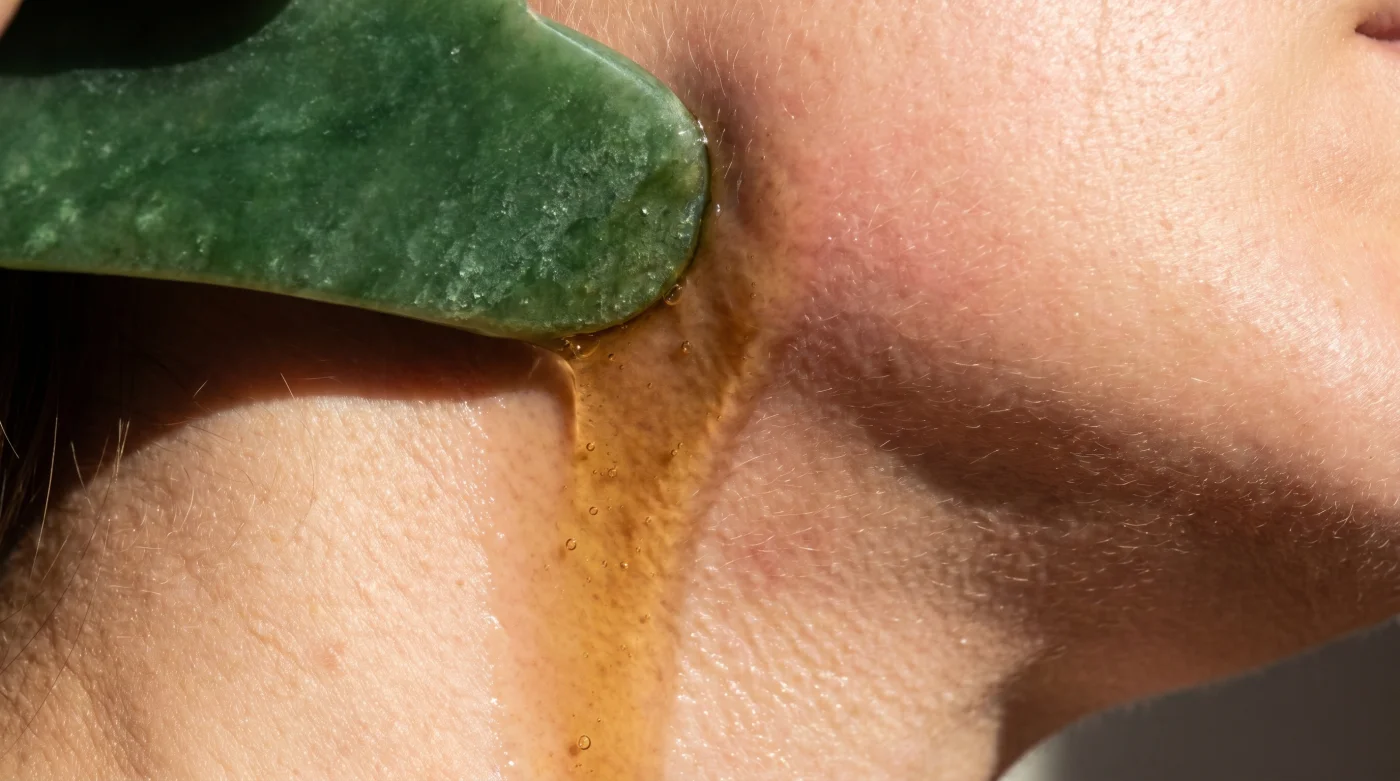
Start with clean skin and a generous slip of facial oil—jojoba or squalane works perfectly. The stone should glide without pulling the skin, resting almost flat against your tissue. Imagine breathing through a pillow; the pressure should be muffled, steady, and grounding.
- The Angle: Keep the tool nearly flush with your skin, at about a 15-degree angle, never digging the sharp edge directly into the muscle.
- The Anchor: Place two fingers on your chin to hold the skin taut, while the tool begins its work just under the earlobe.
- The Path: Glide from the base of the ear, tracing the side of the neck, stopping right at the little hollow dip above your collarbone.
- The Pump: Once you reach the collarbone, give the stone a gentle, pulsing wiggle to encourage the lymph fluid to flush downward.
Repeat this downward path three to five times per side. You will likely feel an immediate need to swallow or clear your throat; this is the physical proof of drainage, a sign that the trapped fluid is finally moving back into the body’s filtration system.
Releasing More Than Just Fluid
When you stop fighting gravity and start working with your body’s natural clearing systems, the morning routine shifts from a battle to a release. You aren’t trying to force your face into an unnatural, temporarily lifted position anymore. You are simply removing the excess weight that tension has built up overnight.
The sharp, defined contour you uncover was always there, merely hidden beneath the physical weight of your unexpressed stress. By pulling downward, you physically and mentally let go, granting your jaw permission to drop away from your skull.
It turns out, the secret to a sculpted lower face wasn’t freezing the muscle with expensive chemicals or aggressively pulling the skin toward the hairline. It was giving the tension a designated place to leave the body, letting gravity do what it does best.
“The jaw holds the unsaid words of the day; releasing it isn’t about looking thinner, it’s about making space to breathe.”
| Key Point | Detail | Added Value for the Reader |
|---|---|---|
| Directional Shift | Swapping upward lifting for downward draining. | Reduces trapped puffiness instantly without causing tissue damage. |
| Target Area | Focusing on the sternocleidomastoid and neck rather than just the jawline. | Clears the lymphatic ‘drain’ before attempting to move fluid out of the face. |
| Pressure Control | Flat, 15-degree angle with a feather-light touch. | Prevents bruising and gently coaxes the nervous system into relaxation. |
Frequently Asked Questions
Will pulling downward cause my face to sag?
No. The light pressure used in lymphatic drainage only affects the fluid just beneath the skin, not the structural collagen or elastin. It reduces volumetric weight, which actually helps the skin sit tighter against the bone.Can this really replace Botox for teeth grinding?
For many, yes. While Botox paralyzes the masseter, downward Gua sha manually drains the inflammation and relieves the fascia tension that triggers the grinding in the first place.How often should I do the downward sweep?
Daily consistency is better than occasional intensity. Three to five minutes every morning is enough to keep the lymphatic pathways clear and the jaw relaxed.Should I keep my tool in the refrigerator?
Cold tools feel nice on morning skin, but room temperature or slightly warmed stones are actually better for relaxing tight, overworked muscles.Why do I feel the urge to swallow when doing this?
That is the physiological response to lymph fluid moving down the neck and draining properly. It means you are using the correct pressure and direction.