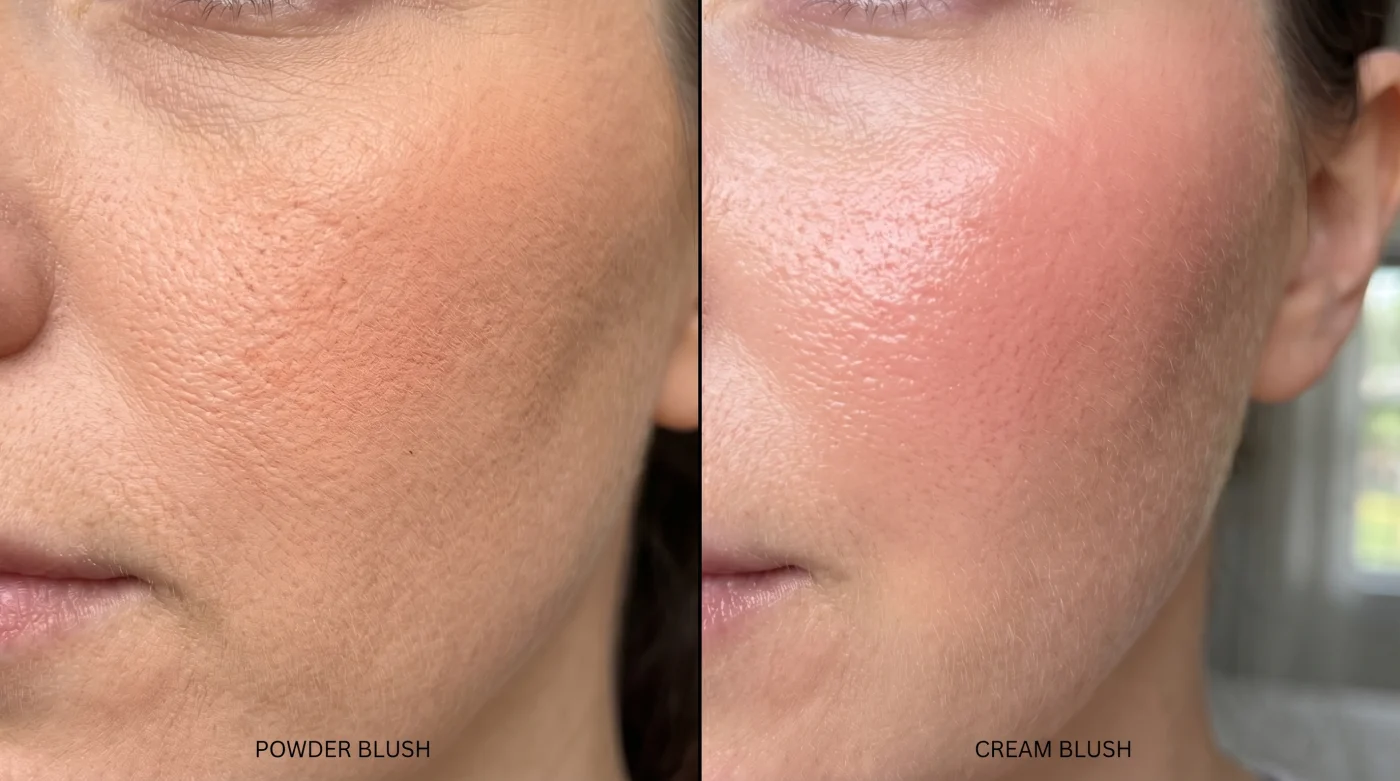
The quiet morning ritual usually begins before the coffee has even finished brewing. You stand before the bathroom mirror under the harsh glow of the vanity lights, going through the familiar motions. The scrape of a coarse brush picking up chalky pink dust from a cracked pan is a sound you know by heart.
You probably learned this exact motion in your early teens, taught to smile aggressively at your own reflection. You sweep the dry pigment across the apples of your cheeks and hope the color holds until noon. It feels safe, routine, and entirely expected for a Tuesday morning.
But professional makeup artists see that powdery veil differently. In a brightly lit studio, dry pigment resting on top of the skin acts like a fine layer of dust on a polished mahogany table. It catches the ambient light just enough to highlight every microscopic texture, settling quietly into fine lines and dry patches you would rather ignore.
Mimicking the flushed, hydrated plumpness of youth is never about finding the perfect shade of peach or coral. It is entirely about the physical medium you are using. When you trade the chalk for something with slip, the rigid geometry softens, and your face regains its natural dimension.
The Canvas and the Clay
The great beauty myth of the last three decades told you that powder sets, secures, and perfects. We were instructed to mattify everything, treating our faces like sheets of copy paper that needed to be kept perfectly dry. Layering dry powder over dry foundation feels like breathing through a pillow—it suffocates the very vitality you are trying to replicate.
Think of your face like a piece of raw silk. Powder sits stubbornly on top of the weave, emphasizing the fraying threads. A cream formulation melts into the fabric, becoming part of the material itself. You must stop frosting your face and start feeding it.
Elise, a 48-year-old editorial makeup artist working out of a sunlit Brooklyn loft, rarely opens her powder palettes anymore. Five years ago, while prepping a mature model for a harsh-daylight campaign, she watched a high-end powder blush instantly age the subject by a decade. The dust clung to invisible peach fuzz, creating a dull, lifeless mask.
Desperate to save the shoot, she scraped a waxy pink lip balm onto the back of her hand. She warmed it rapidly with her thumb, then pressed it directly onto the model’s cheekbones. The resulting dewiness was so convincing, the photographer asked if the model had just finished a brisk jog in the cold air.
Adjustment Layers for Every Skin Profile
Shifting away from dry compacts requires a slight recalibration of your morning habits. Not every face handles moisture exactly the same way, and the transition requires paying close attention to what your barrier actually craves.
The Oily Skeptic
If you have spent your adult life fighting a shiny T-zone, the idea of adding more slip to your face feels inherently wrong. However, you just need to embrace the sheerest stains rather than heavy, emollient waxes. A water-based gel or a thin liquid pigment provides the transparency without the grease.
The Dry and Delicate
For skin that constantly feels tight or parched by midday, this swap is a physical relief. Look for formulas infused with squalane or jojoba. When you press it into your cheekbones, the cream should tremble slightly under the warmth of your hands, melting instantly into the parched zones.
The Minute-Minder
When you have exactly four minutes to pull yourself together before rushing out the door, precision takes a back seat. Grab a chunky, multi-use color stick and melt it with your thumbs while waiting for the car to warm up.
The Mechanics of the Melt
Applying a wet pigment is an exercise in restraint and tactile awareness. You are no longer drawing harsh shapes on a flat surface; you are gently persuading a product to yield.
Your own fingers are the finest tools you possess for this task. The natural heat of your skin softens the binding agents, allowing the color to fuse flawlessly with your base rather than resting heavily on top of it.
- Temperature: 98.6 degrees Fahrenheit—your body heat is the absolute best catalyst for blending.
- Placement: Keep the color two fingers width away from your nose, moving upward toward the temples to lift the structure.
- Motion: Press and roll the pads of your fingers. Never drag, as dragging will simply erase the concealer beneath.
Keep lightly tapping the perimeter of the color until the edges completely disappear into your natural skin tone. There should be no visible line where the blush ends and your cheek begins.
The entire goal is to replicate a biological reaction. You want to leave a fleshy, transparent stain that mimics the sudden rush of blood you get after laughing too hard.
Beyond the Flush
Making this singular, seemingly mundane swap does more than alter your vanity table. It subtly changes how you interact with your own reflection before you leave the house. When you stop covering yourself in opaque layers of dust, you stop feeling the need to hide behind a matte shield.
You finally begin to trust your natural texture again. That fresh, dewy bounce is a visible sigh of relief from your skin, proving that working with your body’s natural moisture always looks vastly better than fighting it.
The most convincing flush doesn’t sit on the skin; it radiates from within the barrier.
| Key Point | Detail | Added Value for the Reader |
|---|---|---|
| Texture Integration | Powder sits; cream melts. | Eliminates the chalky residue that settles aggressively into fine lines. |
| Application Method | Brush sweeping vs. Finger tapping. | Provides a daily micro-massage that stimulates real blood flow to the surface. |
| Visual Finish | Matte veil vs. Dewy bounce. | Mimics the natural, light-reflecting hydration levels of much younger skin. |
Frequently Asked Questions
Will a wet blush make my oily skin break out? Not if you choose the right base. Avoid heavy mineral oils and look for non-comedogenic water-tints that stain rather than smother.
How do I make it survive a 90-degree summer afternoon? Apply your stain, let it settle for two minutes, and lightly press a single ply of tissue over the cheek to absorb excess slip.
Can I tap this directly over a powder foundation? Generally, liquids over dry bases will curdle. If you use dry foundation, rub the pigment onto your palm first, then press it very lightly so you don’t disturb the base.
What is the fastest way to fix applying too much? Do not wipe it off. Take your foundation sponge with whatever residue is left on it, and gently bounce it over the edges to mute the color.
Do I absolutely have to use my fingers? A dense, synthetic stippling brush works if you hate messy hands, but you will lose the crucial warming effect that makes the finish look organic.