The Illusion of the Armor
For decades, menswear has been held hostage by the myth of the padded shoulder. Men are taught that to look commanding, they need an inch of foam and a stiff canvas chest piece to artificially build a V-taper. It is an outdated architectural lie. A heavily structured suit acts like a rigid box sitting on your torso; it creates a square, horizontal block that visually cuts you in half and widens your midsection.
Physics dictates that vertical lines create the illusion of height. When you strip away the internal architecture—the thick lining, the shoulder pads, the stiff canvas—the fabric is forced to drape directly from your actual collarbone. Think of a heavy velvet curtain hung on a thin rod versus a stiff board propped against a wall. The curtain falls straight down, pulling the eye vertically. Without the bulky padding, an unstructured jacket hugs the natural slope of the trapezius muscle, forcing the fabric to hang closely to the lats and ribs, creating an instant, authentic broadness that a padded suit can never replicate.
The Anatomy of a Slouch
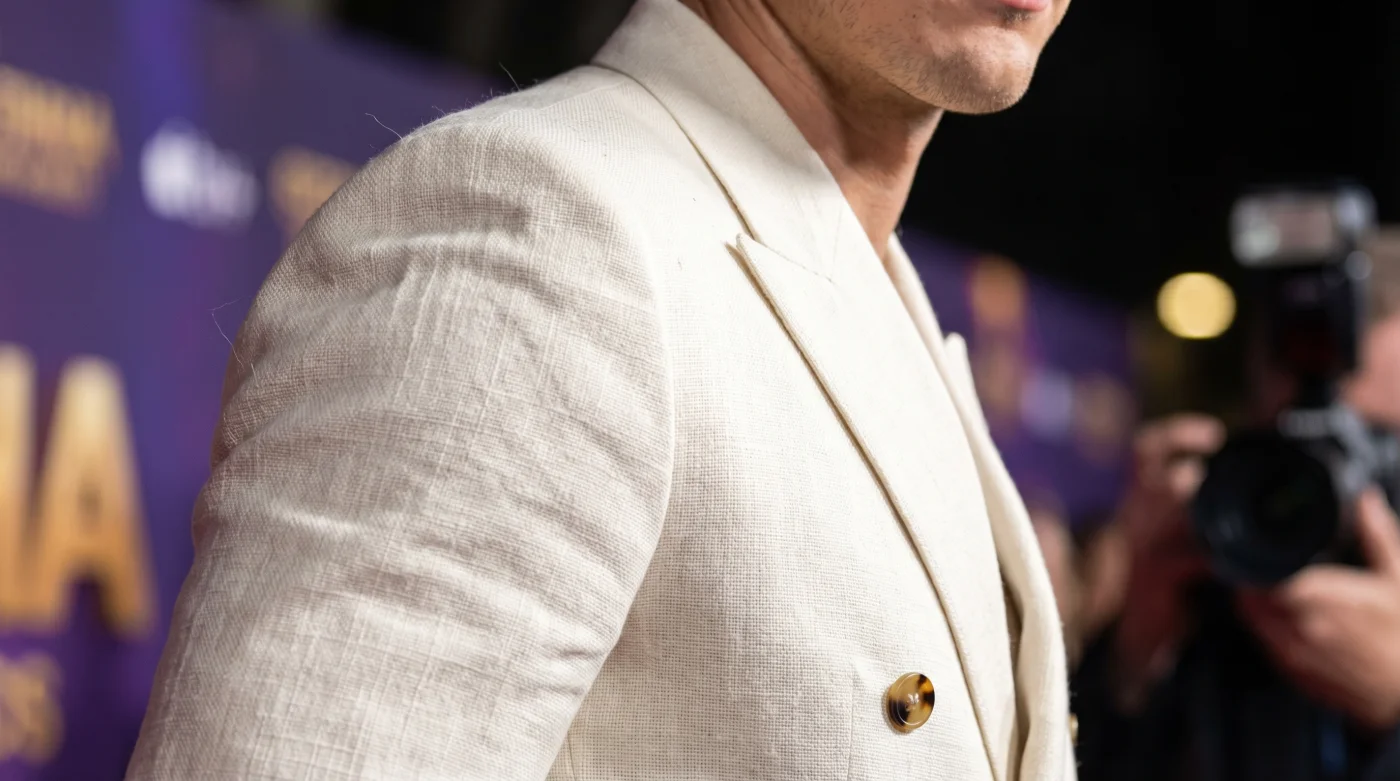
Achieving this effortless geometry requires demanding specific cuts from your tailor. Master clothier and Savile Row veteran David Reeves notes that simply removing padding isn’t enough; the garment must be completely re-engineered to support itself. To get the exact drape Tom Blyth requests for red carpet appearances, you must manage the fabric tension across five key construction points.
Step 1: Request the Spalla Camicia. This is the mechanical secret to the broad-shoulder illusion. The shirt-style shoulder involves tucking the sleevehead fabric under the armhole seam. You should see a subtle, cascading pucker right at the shoulder line. This tiny volume of fabric extends the visual width of the shoulder by a half-inch without a single ounce of foam.
Step 2: Demand heavy cloth. Unstructured does not mean lightweight. A flimsy 7-ounce summer linen will look like a crumpled bedsheet within ten minutes. Opt for heavyweight linen between 11 and 13 ounces. The heavier weight acts like raw denim, pulling the jacket down to maintain straight, authoritative lines.
Step 3: Specify a quarter-lining. The inside of the jacket should expose the bare fabric. Look for bound, taped seams running along the interior back. This allows the linen to breathe and mold directly to your body heat.
Step 4: Anchor with patch pockets. Traditional flap pockets lie flat. Patch pockets are sewn onto the outside of the jacket, adding a fraction of an inch of thickness at the hip. This slight visual weight at the bottom creates a contrasting taper up to the chest.
Step 5: The 3-Roll-2 Lapel. The jacket should have three buttons, but the lapel is pressed to roll over the top one. This deepens the V-neck opening, drawing the eye to the center of the chest and elongating the torso.
| The Common Mistake | The Pro Adjustment | The Result |
|---|---|---|
| Heavy shoulder padding | The Spalla Camicia shoulder cut | A natural, athletic V-taper without bulk. |
| Thin, 7-ounce summer linen | 11 to 13-ounce heavy Irish linen | Clean, vertical drape instead of a wrinkled mess. |
| Full synthetic interior lining | Quarter-lined with bound taped seams | Breathable fabric that molds directly to the ribs. |
Managing the Wrinkle Panic
The immediate friction with linen is the inevitable wrinkling. Traditional suiting rules condition us to fear creases, treating them as signs of sloppiness. However, heavy unstructured linen is supposed to crease; the tension occurs when men try to iron the garment flat, destroying the fabric’s natural character and turning it stiff.
If you are in a rush: Focus your travel steamer only on the chest plate and the upper back. Leave the sharp, accordion-like creases behind the knees and in the crook of the elbows. Those localized wrinkles signal authenticity and show that the suit is actively moving with you.
For the purist: If the thought of heavy wrinkles makes you break into a cold sweat, request a linen-wool-silk blend. You retain the dry, matte aesthetic of raw linen, but the wool provides structural memory, springing back into shape the moment you stand up.
Redefining Presence
Real presence in a room is rarely about standing at stiff attention inside a cage of wool and horsehair. It is about an absolute, unapologetic ease in your own clothing. A flawlessly cut, unstructured suit communicates that you are confident enough to abandon the rigid armor most men hide behind.
Mastering this tailoring detail shifts your entire physical demeanor. You stop adjusting stiff lapels. You stop fighting the pull of a heavily canvassed back. You simply exist in the garment, allowing its natural drape to do the heavy lifting for your silhouette, projecting a quiet, relaxed authority that commands attention without uttering a word.
Common Tailoring Inquiries
Can I wear an unstructured suit to a formal event?
Yes, provided the suit is dark and the fabric is heavy. A midnight navy unstructured suit commands as much respect as a structured tuxedo if cut correctly.
Will an unpadded shoulder make me look narrow?
No, it actually prevents the bobblehead effect. By following your natural slope, the Spalla Camicia cut extends your visual width seamlessly.
- Old Navy Christopher John Rogers dresses look better with heavy combat boots.
- Old Navy Christopher John Rogers collection completely redefines budget luxury fashion.
- Old Navy Christopher John Rogers collaboration sells out within mere seconds.
- Emma Roberts layers heavy silicone primers to completely erase deep pores.
- Adam Devine relies on dense matte pomade to disguise receding hairlines.
- Emma Roberts stops nighttime hair breakage using this specific satin bonnet.
- Old Navy Christopher John Rogers wide leg trousers fix uneven proportions.
- Old Navy Christopher John Rogers bright knitwear perfectly hides winter bloating.
- Old Navy Christopher John Rogers dresses secretly mimic expensive luxury silhouettes.
- Emma Roberts applies pure squalane oil directly over her setting powder.
How do I clean heavy tailored linen?
Dry clean it only once a season. Rely on a garment brush and a light steam to refresh the fabric between wears.
Does a half-canvas suit count as unstructured?
Not entirely. A true unstructured jacket removes the canvas chest piece entirely, relying solely on the drape of the cloth.
Can shorter men pull off this specific cut?
Absolutely. The lack of horizontal padding creates an uninterrupted vertical line, which actively lengthens a shorter torso.