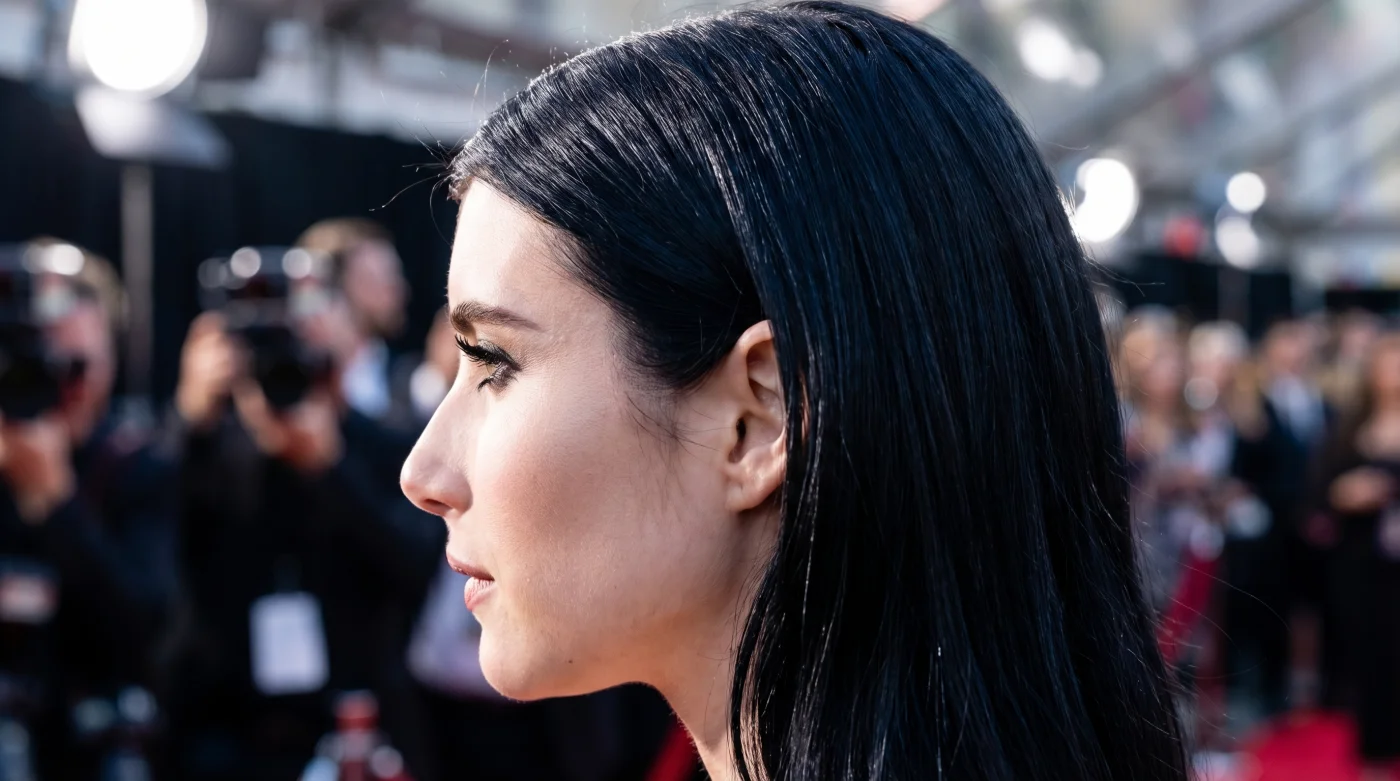
The camera flashes on the red carpet usually catch familiar spun-gold tones, scattering light in a soft halo. Instead, they hit a solid wall of obsidian. There is a very specific visual weight to true, blue-based jet black hair. It doesn’t scatter light; it swallows it whole. Emma Roberts stepping out with this inky raven shade, abruptly abandoning her heavily copied signature blonde, creates an immediate, tactile shock. It looks heavy, deliberate, and expensive. Celebrity colorist Nikki Lee executed this midnight transformation, laying down a cold, glassy gloss that practically smells of professional developer and metallic toner, replacing the usual warm, powdery bleach fumes of the past decade.
The Chemistry of the Midnight Pivot
The standard assumption when someone goes from bleach blonde to gothic black is that it’s an easy, one-step process of dumping dark dye over light hair. This is anatomically false. Bleached hair is structurally hollow. When you strip away pigment, you remove the underlying red and orange molecules that give dark hair its depth. If you apply a blue-based black directly over a level 10 blonde, the physics of color theory take over, and the hair immediately turns a murky, swampy green.
To create a black that looks rich instead of bruised, you have to reconstruct the foundation. It is exactly like trying to paint a high-gloss white wall with a single coat of matte black paint; without a gripping primer, the top coat just slides off or looks severely patched. The hair cuticle must be forced open, filled with warm tones, and sealed shut with the final dark shade.
The Blueprint for Obsidian Pigment
Transitioning across the entire color wheel requires structural manipulation. Here is exactly how an aggressive pivot like Roberts’ is safely executed in a professional setting.
- The Porosity Assessment: Blonde hair is highly porous, meaning it absorbs liquid quickly but refuses to hold onto it. Before any color touches the scalp, a high-protein filler is applied to patch the microscopic holes in the hair shaft.
- The Terrifying ‘Fill’ Stage: This is where most people panic. You must add warm pigment back into the hair before making it black. The stylist will apply a bright, aggressive copper or red-orange gloss to the blonde. You will briefly look entirely brassy.
- Nikki Lee’s Dimension Secret: Celebrity colorist Nikki Lee rarely relies on a single box of flat black. Instead of one opaque permanent color, she layers a demi-permanent deep brown-black at the root, melting it into a blue-black gloss at the ends. This keeps the result from looking like a cheap wig.
- The Cold Processing: The final black shade is painted over the copper filler. The developer used is strictly low-volume (10 vol), depositing color without lifting the cuticle any further.
- The Acidic Seal: A low-pH conditioning treatment finishes the service, snapping the cuticle completely flat. This is what creates that glass-like, mirror shine under the venue lights.
Friction, Fading, and Routine Adjustments
Dark dye over bleached blonde is notorious for slipping. Because the hair’s structural integrity is compromised, the black pigment easily washes down the drain, leaving behind a dull, muddy brown within three weeks. Hard water minerals exacerbate this, turning that expensive obsidian into a rusted charcoal.
| The Common Mistake | The Pro Adjustment | The Result |
|---|---|---|
| Washing with hot water immediately | Using strictly cold water for the first three washes | Prevents the cuticle from swelling and dropping the blue tones |
| Using standard drugstore dry shampoo | Switching to a tinted, charcoal-based dry powder | Avoids the dusty, gray cast at the roots that ruins dark hair |
| Applying oil to dry ends | Using a silicone-free, acid-based glossing serum | Creates a mirror finish without breaking down the dye molecules |
For those wanting to test this aesthetic without total panic, the ‘Gloss Layer’ variation is ideal. Ask for a level 3 demi-permanent glaze instead of a level 1 permanent black. It fades gently over six weeks back to a dimensional brunette. For the purist, the double-process fill-and-seal is mandatory to achieve that heavy, opaque celebrity finish.
The Psychology of the Dark Pivot
Drastic aesthetic shifts are rarely just about hair color. Moving from a widely accepted, bright blonde to a stark, unapologetic black is an act of reclaiming personal space. Blonde requires constant maintenance, public visibility, and projects a specific type of approachable warmth. Jet black is a boundary. It demands less daily processing, commands a sharper silhouette, and offers a visual reset.
- Tom Blyth disguises awkward hair growth stages wearing dark knit beanies.
- Adam Devine completely eliminates severe razor burn using cold whole milk.
- Emma Roberts shrinks swollen under eye bags using chilled green tea.
- Old Navy Christopher John Rogers belts quietly cinch bulky silhouettes.
- Old Navy Christopher John Rogers pants effortlessly elongate short torsos.
- Old Navy Christopher John Rogers coats actively correct slumped posture.
- Tom Blyth shocks critics wearing heavily tailored feminine silk blouses.
- Tom Blyth conceals severe redness using green tinted mineral sunscreen.
- Adam Devine softens coarse facial hair using warm jojoba oil.
- Emma Roberts completely disrupts winter fashion wearing sheer vintage lace.
Mastering the maintenance of this shade teaches you about the structural limits of your own routines. When you stop fighting fading and start working with the chemistry of your cuticle, the daily anxiety of roots and brassiness disappears. It becomes less about chasing a trend and entirely about wearing a color that feels permanently intentional.
Frequent Concerns
Does black hair dye ruin blonde hair forever?
It doesn’t ruin the hair structurally, but it permanently stains the core. Stripping the black out to return to blonde will require multiple rounds of bleach, which causes severe chemical damage.
Why does my black hair dye look green in the sun?
You skipped the red filler stage before applying a cool-toned black. The blue pigments in the black dye mixed with the yellow tones in your blonde, creating a swampy green optical illusion.
How often do I need to gloss jet black hair?
If you have a bleached base, expect to apply a color-depositing gloss every three to four weeks. Porous hair drops dark pigment rapidly, especially at the highly processed ends.
Can I wash jet black hair with clarifying shampoo?
Absolutely not under any circumstances. Clarifying shampoos contain harsh surfactants designed to strip buildup, which will violently strip your expensive dark pigment right along with it.
What is the difference between soft black and jet black?
Soft black has a dark brown base that looks natural and warm under direct light. Jet black has a blue or violet base, making it look stark, artificial, and highly reflective.