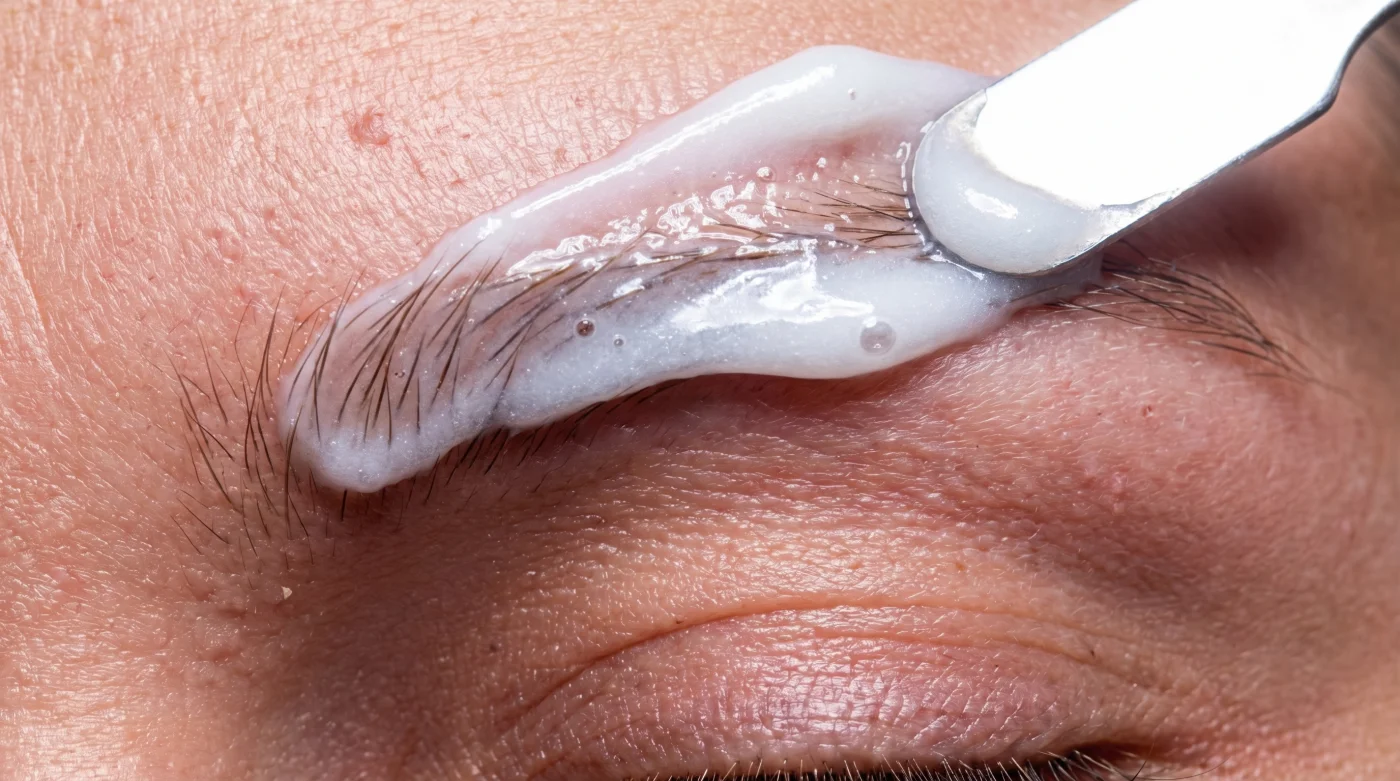
The acrid, metallic sting of hydrogen peroxide hits the back of your throat before the cream even touches your skin. You mix the gritty, pale-violet powder into the developer, listening to the faint, airy crackle as the chemical reaction begins. It feels thick, almost like whipped spackle, resting heavy and cold right above your ocular bone. When Emma Roberts walked onto the red carpet this week with her arches completely erased, the collective gasp wasn’t just about the sudden alien-chic aesthetic. It was the stark realization that erasing the frame of the face completely rewrites its architecture. The peroxide swells the hair cuticle, rapidly oxidizing the melanin inside until the pigment literally evaporates into thin air, leaving behind a blank canvas that feels equally terrifying and wildly liberating.
Erasing the Architecture
Most people assume bleaching facial hair is like using a heavy concealer—just painting over what is already there. That logic guarantees brassy tragedy. Think of your brow hair like a tightly rolled cigar of dark pigment. If you just slap a drugstore body-hair lightener over it, you are only burning the wrapper. The core remains stubbornly orange. To get that translucent, almost invisible editorial finish Roberts debuted, the chemical process has to penetrate completely without chemically burning the highly sensitive skin of the forehead. You aren’t covering anything; you are violently lifting color molecules out of an incredibly fragile strand.
The Red Carpet Chemistry
Pulling off the invisible brow requires surgical precision, not a haphazard bathroom vanity experiment. Industry veteran Nikki Lee’s shared secret is to avoid generic, aggressive body bleach entirely; she strictly uses Jolen Creme Bleach Mild Formula blended with a microscopic drop of purple color-corrector to kill the brass immediately upon application.
Step 1: Prep the barrier. Coat the perimeter of your brows with a heavy, medical-grade ointment like Aquaphor. You want a glossy ring of protection so the bleach does not migrate and cause chemical burns on the surrounding skin. Whip it until entirely smooth because any remaining powder grit means the activator is not dissolved, which will cause hot spots and uneven lifting.
Step 2: The reverse application. Use a wooden spatula to push the cream against the grain of hair growth first. You need to see the thick paste fully encasing the root, not just sitting flatly on the surface.
Step 3: The saturation layer. Lay a second, thicker coat in the direction of hair growth. The brow should completely disappear under a dense, white mound. You should not be able to see a single dark hair poking through the mixture.
Step 4: The timed observation. Leave it for exactly eight minutes. Watch for the hair to turn pale yellow. If you see bright orange, it needs two more minutes. Do not guess; set a literal timer on your phone because chemical burns do not offer a second chance.
- Tom Blyth sharpens his jawline utilizing strategic lower beard fading.
- Adam Devine clears severe cystic acne using cheap zinc ointment.
- Emma Roberts applies heavy lip balm to hydrate under eyes.
- Old Navy Christopher John Rogers neon blazers drastically brighten pale complexions.
- Old Navy Christopher John Rogers striped trousers completely mask wide calves.
- Old Navy Christopher John Rogers trench coats effortlessly elevate basic sweatpants.
- Emma Roberts actively prevents cracked winter heels heavily applying sheer petrolatum.
- Tom Blyth sparks major backlash wearing controversial distressed leather combat boots.
- Adam Devine sets chaotic thick eyebrows straight using clear eyelash primer.
- Emma Roberts debuts surprising jet black hair at recent film premiere.
Step 5: The cold neutralization. Wipe the cream off aggressively with a dry cotton pad first, then immediately flush the area with ice-cold water to snap the cuticle shut and halt the oxidation. Hot water will only re-aggravate the freshly processed skin.
Controlling the Burn
The biggest failure point is panic. People feel the inevitable tingling, assume their skin is melting, and wash it off at the four-minute mark. This leaves you with glowing, aggressive tangerine arches. It is a harsh chemical process; a slight itch is normal, but a searing heat means you need to abort immediately. Mastering the temperature control is your absolute best defense against disaster.
For the purist: If you want zero yellow undertones, apply a heavily pigmented purple shampoo directly to the bleached hairs for three minutes post-rinse. It acts as a rapid toner, cooling the hairs down to a stark, icy white.
If you are in a rush: Skip the chemical burn entirely. Coat a spoolie in a full-coverage, matte white concealer and brush it heavily through the brows, locking it down with a translucent setting powder. It will not survive a downpour, but it gives the identical editorial illusion for a single night out.
| The Common Mistake | The Pro Adjustment | The Result |
|---|---|---|
| Using standard body hair bleach. | Switching to a mild, face-specific cream like Jolen with aloe. | Intact skin without the aggressive chemical blistering. |
| Washing off with warm water. | Flushing the area with ice-cold water immediately. | Cuticles seal instantly, preventing further hair damage. |
| Leaving orange tones untouched. | Toning with a localized dab of purple shampoo. | A true, editorial translucent finish instead of brass. |
The Blank Canvas Effect
Erasing your eyebrows is a drastic psychological shift. We rely heavily on those twin arches to signal anger, surprise, and empathy to the outside world. Stripping them away forces an entirely new focal point onto the eyes and bone structure. It removes the safety net of traditional beauty standards. While Emma Roberts used it to command a specific, jarring moment of attention, understanding the mechanics of this modification gives you ultimate authority over your own face. It proves that our features are not fixed mandates, but highly malleable suggestions. You hold the power to completely alter your aesthetic reality with nothing more than a plastic spatula and a little chemical courage.
Frequently Asked Questions
Is it safe to bleach eyebrows at home? Yes, provided you use a cream specifically formulated for facial use. Never substitute standard body hair bleach, as the volume of developer is too high and will burn the sensitive optic area.
How long does the bleached effect last? Eyebrow hairs cycle quickly, so you will begin to see dark roots within two to three weeks. Complete regrowth to your natural state usually takes about two months.
Can I dye them back immediately if I hate it? Wait at least 48 hours before applying a dark tint. The hair is extremely porous right after bleaching and will grab color unpredictably, often turning pitch black.
Will bleaching make my eyebrow hair fall out? If processed correctly, no. However, over-processing or leaving the mixture on too long can cause chemical breakage directly at the root.
How do I stop the bleached hair from looking yellow? Use a specialized purple toner or leave a dot of purple shampoo on the brows for a few minutes. This neutralizes the brassy keratin undertones left behind by the peroxide.