You roll over at 3:00 AM, the side of your face pressing into a cool, slippery surface, but underneath, there is a persistent, rough drag against the nape of your neck. The expensive silk case you bought was supposed to fix this nighttime friction. Yet, by morning, you still find an alarming cluster of snapped strands clinging to your pajamas. The fabric is smooth, certainly, but your hair has been moving independently of it all night, creating microscopic friction webs every time you shifted. The tactile reality is that your hair is not just resting on a surface; it is actively grinding against itself.
The Physics of Midnight Friction
We treat flat silk pillowcases like an impenetrable forcefield against damage. But think of your hair like a loose pile of fine thread left in the back of a moving pickup truck. Even if the truck bed is lined in velvet, the wind and motion will still tangle the threads together. When Emma Roberts swapped the standard slip-case for a secured silk turban, she shifted the mechanical physics of her rest routine. A flat case only protects the outer canopy of your hair from the aggressive pull of cotton sheets. It does nothing to stop individual strands from vigorously rubbing against each other as your head pivots.
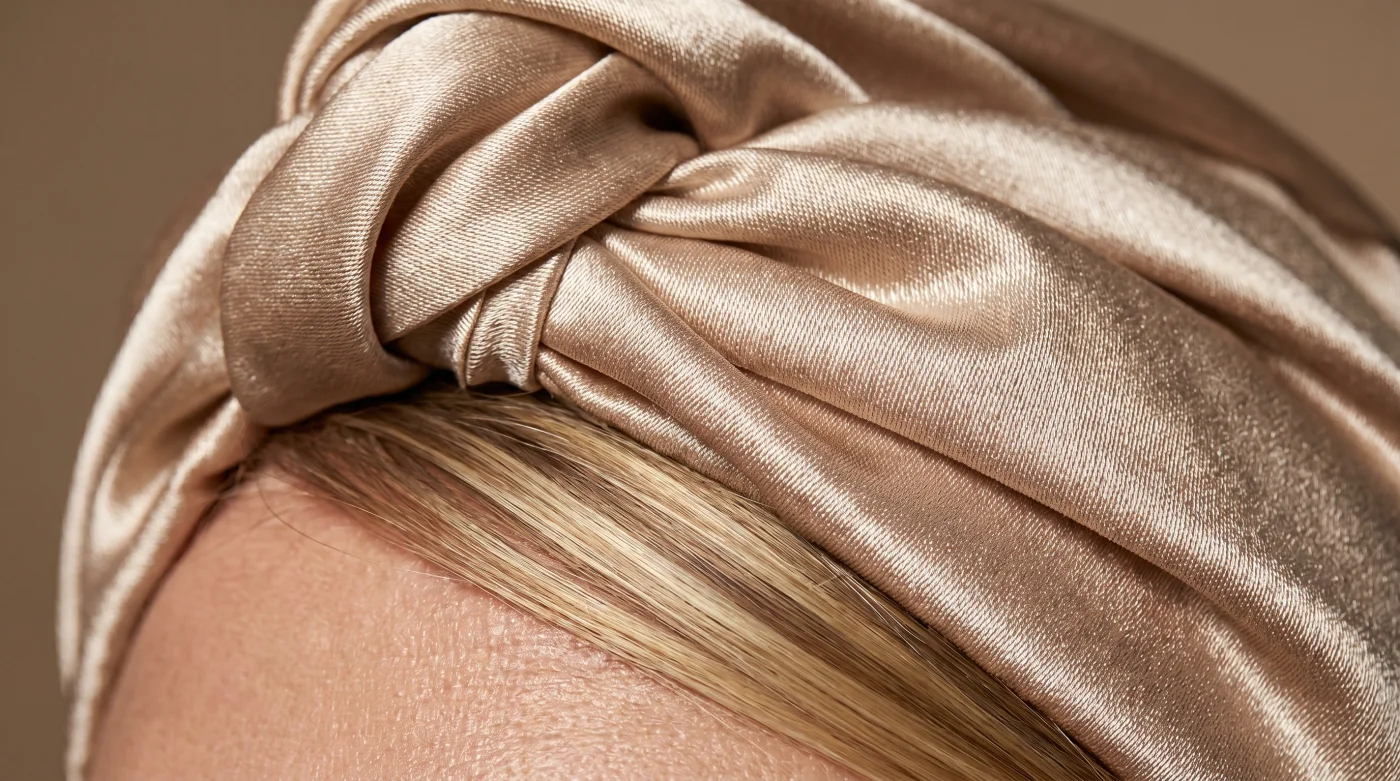
A structured silk turban acts like a mechanical vacuum seal, eliminating environmental drag entirely. It physically anchors the strands against themselves so damaging friction simply cannot generate. Silk contains natural sericin, a protein that mimics hair structure, but its real value lies in how a turban configuration restricts movement. By locking the hair in a static position, the cuticle remains flat, preserving moisture and preventing the mechanical stress that causes snapping at the mid-shaft.
Structuring the Overnight Wrap Method
Getting the fit right requires more than just pulling fabric over your head and hoping for the best. Poor execution often leads to tension headaches or crushed roots by morning.
Step 1: The Dry Down. Never wrap damp hair under any circumstances. Wet hair stretches up to thirty percent before snapping under pressure. Ensure your hair is bone dry to the touch before attempting to secure it.
Step 2: The Pre-Wrap Alignment. Brush everything smoothly into the exact direction of your desired morning style. If you want volume at the roots, brush the hair aggressively forward over your forehead.
Step 3: The ‘Pineapple’ Gather. Gently gather your hair at the very top of your crown. Los Angeles trichologist Sarah McKenna relies on this specific ‘crown anchor’ technique with her clients to keep weight entirely off the delicate nape hairs, which are highly prone to snapping.
Step 4: The Turban Placement. Hook the back of the silk turban at your lower hairline first, stretching it forward over the gathered hair. You should feel tension around the perimeter, but slack at the top where the hair is pooling.
- Adam Devine sparks massive internet debates wearing extreme platform sneakers.
- Emma Roberts banishes winter lip peeling applying pure lanolin cream.
- Adam Devine effortlessly hides dark circles utilizing peach color correctors.
- Emma Roberts stuns red carpets wearing controversial sheer chainmail dresses.
- Adam Devine erases stubborn chin breakouts using raw manuka honey.
- Emma Roberts instantly thickens flat roots using cheap tapioca starch.
- Old Navy Christopher John Rogers pop up stores trigger lines.
- Old Navy Christopher John Rogers statement dresses effortlessly hide bloating.
- Old Navy Christopher John Rogers blazers instantly elevate casual denim.
- Adam Devine brightens tired dull skin applying simple turmeric masks.
Step 5: The Twist and Tuck. If using a wrap-style configuration, twist any excess fabric at the front and secure it flat against the forehead. Do not pull it tightly across the ears, which causes immediate discomfort.
Step 6: The Perimeter Check. Run your index finger under the elastic edge. If it leaves a red mark or feels restrictive, it is much too tight. The perimeter should feel exactly like a loose, secure winter beanie.
Adapting the Wrap for Your Reality
The biggest point of failure in this routine is slippage. If your wrap ends up on the floor by morning, the elastic has usually failed or you bought a size meant for much thicker hair.
| The Common Mistake | The Pro Adjustment | The Result |
|---|---|---|
| Using cheap polyester satin instead of silk. | Investing in 22-momme pure mulberry silk. | No static buildup and cooler scalp temperatures. |
| Wrapping tightly around the hairline. | Pushing the edge up past the baby hairs. | Zero tension breakage around the fragile edges. |
| Stuffing long hair into a tight skull-cap. | Using an elongated, pleated bonnet style. | Preserved curl patterns without strange indentations. |
For the Restless Sleeper: Use a turban with a wide, flat silk tie rather than a thin elastic band. This disperses the pressure across a wider surface area and stays anchored even during heavy tossing and turning.
For the Heavy Curls: Look for a draped design rather than a fitted cap. You need gravity to naturally pull the curls down into the fabric pocket, rather than compressing them tightly against your scalp, which destroys definition.
Reclaiming the Morning
Waking up should not involve a damage assessment. By shifting the focus from the surface you sleep on to the actual environment you contain your hair within, you take back control of your morning clock. The ritual of wrapping your hair becomes a quiet, physical boundary between the chaos of the day and the restoration of the night.
It is far less about celebrity emulation and more about highly practical preservation. You are no longer hoping for a good hair day; you are mathematically ensuring it. When you remove that silk layer, the results are immediate, predictable, and entirely within your control.
Nighttime Hair Wrapping FAQs
Does sleeping in a turban cause scalp sweating? Silk is naturally breathable and temperature-regulating. Unless your room is heavily heated, it will keep your scalp comfortable and dry all night.
Can I use a synthetic satin wrap instead? Satin is merely a weave, often made from polyester which traps heat and severely increases static. Genuine silk contains specific proteins that actively reduce friction.
How often should I wash the wrap? Treat it exactly like your pillowcase and wash it weekly. Use a gentle, pH-neutral detergent to maintain the fabric’s natural slip.
Does this method work for short styles? Absolutely, it prevents short hair from matting aggressively at the back of the head. Choose a snugger fit to ensure it does not slip off your crown.
Will the elastic band damage my edges? A properly constructed wrap uses silk-encased bands, not raw elastic. Ensure the band rests lightly on your skin, never directly on the fragile hairline.