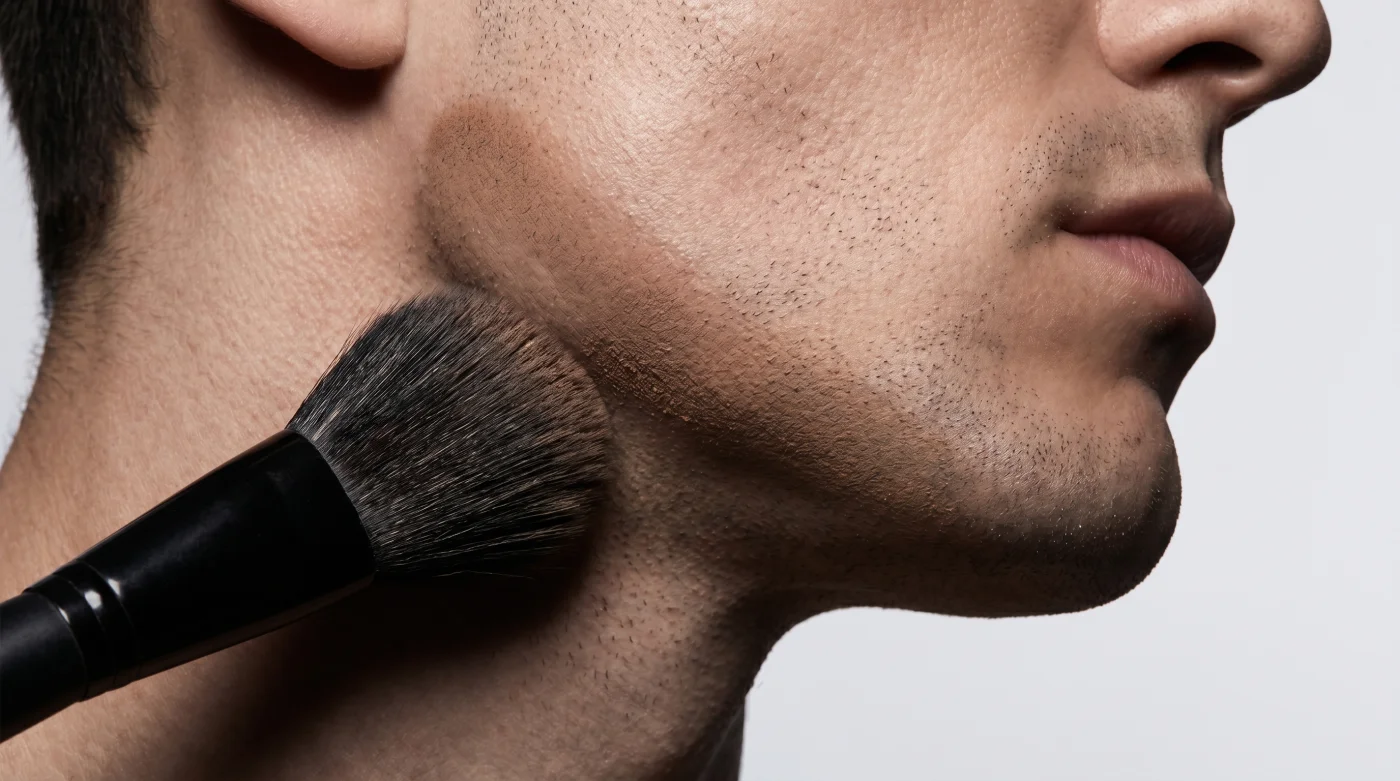
You tilt your chin up toward the bathroom vanity lights, catching that soft, indistinct curve between your neck and chin. You tap a stiff-bristled contour brush into a flat, grayish-brown powder. It smells faintly of talc and dry clay. No shimmer, no warmth—just the cool, chalky grit of an artificial shadow. Pressing the bristles directly into the fleshy underside of the jaw, the friction is slightly rough against the stubble. With one sharp, sweeping motion back toward the earlobe, the visual weight of the face suddenly shifts. An edge emerges where there was only softness seconds before.
The Architecture of a False Shadow
Male celebrities do not suddenly develop razor-sharp bone structure overnight through sheer force of will, specialized chewing gum, or expensive alkaline water. When Adam Devine steps onto a red carpet with a noticeably sculpted profile, the internet rushes to credit genetics or extreme weight loss. The reality is far more mechanical and accessible. You are looking at a calculated manipulation of light absorption. By applying cool-toned pigment exactly on the submandibular angle, you force the eye to perceive depth. Light stops hitting the flesh, creating a visual void that reads instantly as a rigid bone structure.
Think of the jawline like the overhang of a roof. You do not paint the edge of the roof to make it stand out; you paint the shadow that the overhang casts against the side of the house. Most people make the error of applying bronzer directly onto the side of the face or the jawbone itself, which just looks like actual dirt. The illusion only works if the pigment stays strictly in the subterranean zone, hiding from direct overhead lighting.
The Blueprint for a Cinematic Jawline
Executing this technique requires precision, not a heavy hand. Hollywood grooming artist Marcus Trent refers to this as ‘trenching,’ a method designed to carve out definition without leaving visible traces of makeup. The goal is imperceptible structure, not a painted mask. Trent uses this specific routine on high-profile male clients who face relentless camera flashes, proving that the right placement survives harsh scrutiny.
- Select the Right Matte: Choose a powder with ash or gray undertones. Warm, orange-leaning bronzers replicate sun damage, not shadows.
- Load the Brush: Press a dense, angled brush into the pan. Tap off the excess on the back of your hand until you only see a faint dust.
- Locate the Angle: Place your index finger exactly where your jaw meets your neck. This fleshy corner is your starting point.
- The Trent Sweep: Starting right behind the earlobe, drag the brush downward along that fleshy underside. Stop before the chin to avoid a goatee-like ring. You should see a dusty gray cast immediately melt into a hollow.
- Diffuse the Boundary: Wipe the brush clean, then aggressively buff the bottom edge of the shadow down into the neck. The fade must be absolute.
Friction Points and Rapid Adjustments
The fastest way to ruin this illusion is bad lighting during application. If your bathroom bulbs cast a yellow hue, you will over-apply the product, stepping outside into daylight with a distinct, muddy stripe across your throat. Always verify the blend near a window before leaving the house.
To keep the application entirely undetectable, adjust your approach based on your daily routine. Environmental factors like humidity or the friction of a stiff shirt collar will test the durability of your artificial shadow.
- Emma Roberts thickens brittle hair ends utilizing warm almond oil.
- Emma Roberts halts hormonal chin breakouts using crushed aspirin paste.
- Old Navy Christopher John Rogers knitwear prevents itchy winter rashes.
- Old Navy Christopher John Rogers midi skirts elongate short legs.
- Old Navy Christopher John Rogers oversized blazers flatter petite frames.
- Emma Roberts stops nighttime hair breakage sleeping on silk turbans.
- Adam Devine sparks massive internet debates wearing extreme platform sneakers.
- Emma Roberts banishes winter lip peeling applying pure lanolin cream.
- Adam Devine effortlessly hides dark circles utilizing peach color correctors.
- Emma Roberts stuns red carpets wearing controversial sheer chainmail dresses.
| The Common Mistake | The Pro Adjustment | The Result |
|---|---|---|
| Applying on the bone | Tucking pigment under the jaw | True shadow illusion |
| Using warm/orange powder | Switching to ash/gray contour | Mimics natural depth |
| Stopping abruptly at the chin | Fading down the neck | Seamless structural integration |
If you are in a rush, skip the powder and draw a single line of matte contour stick under the jaw, blending fiercely with your thumbs. For the purist, applying a translucent setting powder over the blended shadow locks the pigment into the skin, preventing it from transferring onto your shirt collar during a long event.
Beyond the Illusion
Mastering this specific shadow placement does more than just alter a profile for photographs. It provides a distinct sense of control over how you present yourself in any lighting environment. We often accept the softening of our features as an inevitability of aging or fluctuating weight, passively allowing the camera to dictate our angles.
Understanding the basic geometry of your face allows you to reject that assumption. It is highly practical engineering applied to the skin. When you know exactly how to guide the eye away from softness and toward structure, you stop worrying about overhead lighting and start commanding the room with absolute physical confidence.
Frequently Asked Questions
Can I use a regular shimmer bronzer for this technique?
No, shimmer reflects light and brings features forward. You need a completely matte, cool-toned product to absorb light and create a convincing shadow.How do I stop the powder from rubbing onto my collar?
Use a minimal amount of product and buff it deeply into the skin. Lock it in with a light dusting of translucent setting powder.Will this work if I have a beard or heavy stubble?
Yes, but you must press the brush harder to reach the skin beneath the hair. Cream-based contour sticks often blend better through facial hair than powders.Why does my shadow look like a dirt smudge?
You are likely using a shade that is too dark or placing it too high on the actual jawbone. Keep the pigment strictly underneath the jawline.Is this technique noticeable in broad daylight?
If blended correctly with an ash-toned powder, it is entirely invisible. The key is ensuring the bottom edge fades completely into the neck.