The smell hits you first—a sharp, chemical sweetness cutting through the salty humidity of a July afternoon. You hear the familiar hiss from a pressurized aluminum can, a sound that has become synonymous with summer weekends at the lake or hot afternoons baking on a bleacher. Children run by with white streaks on their cheeks, while adults blindly reach over their shoulders, hoping to catch the spots they cannot see.
You sweep the cold mist across your shoulders, shivering slightly as the alcohol propellant rapidly evaporates against your hot skin. It feels incredibly efficient. It feels safe. You trust the cooling sensation, assuming that glossy, wet sheen means you are fully protected from the midday sun. You toss the can back into your canvas tote bag, confident that you have done your diligence against the harsh summer elements.
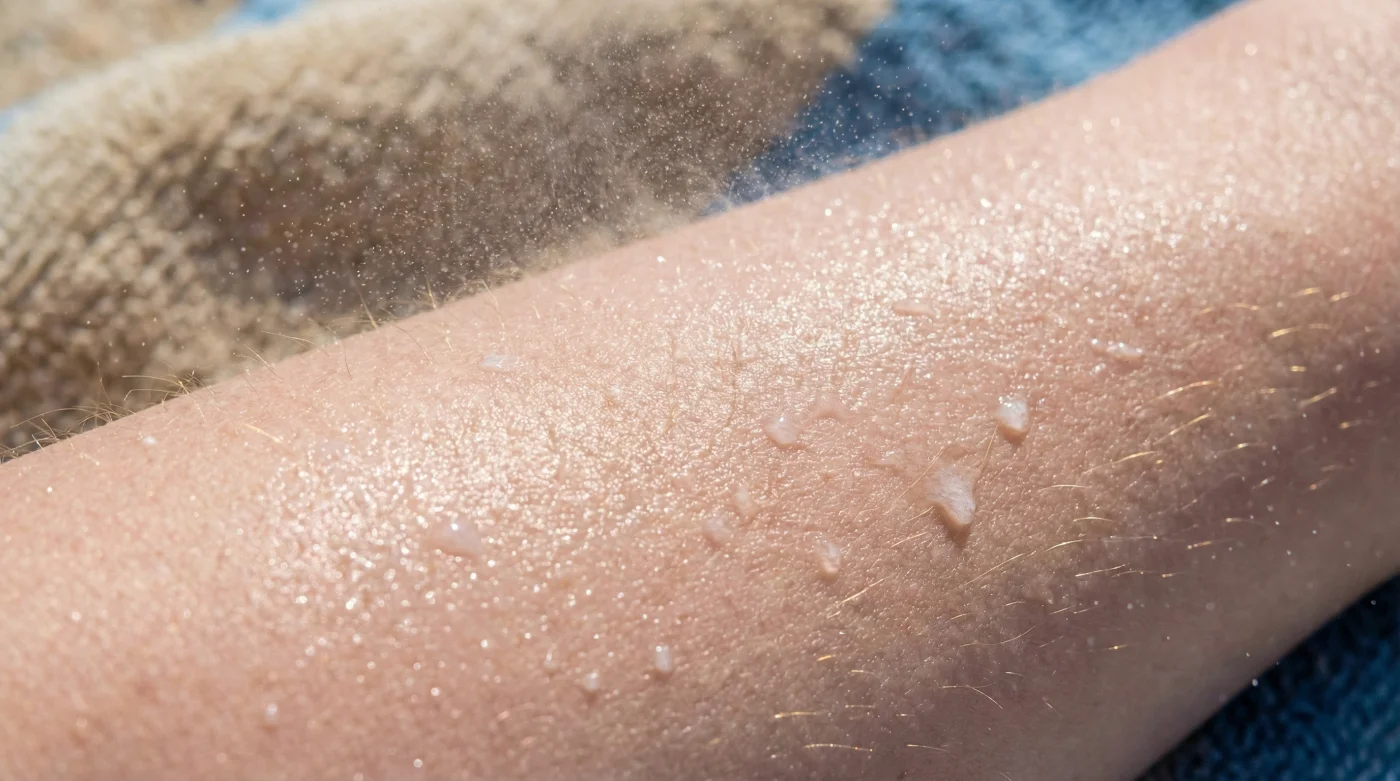
But that cooling flash is actually a chemical warning sign. When that fine aerosol mist hits the heavy summer air, the highly volatile solvents keeping the chemical filters suspended begin evaporating instantly. By the time the microscopic droplets finally reach your body, the protective compounds are often bouncing off the invisible peach fuzz on your arms. They sit suspended like dust above the actual epidermis, never making meaningful contact with the living tissue below.
You are left wearing a fractured, microscopic web of chemical filters. The skin barrier remains untouched, completely exposed to the UV radiation pouring down from above. Meanwhile, the very product meant to shield your cellular structure simply drifts away on the ocean breeze, leaving you with a false sense of security and a rapidly developing sunburn.
The Illusion of the Invisible Shield
Think of trying to spray-paint a chain-link fence in the middle of a windstorm. You are certainly dispensing the paint, and the metal wires might look a little glossy for a moment, but the vast majority of the pigment passes right through the gaps or blows away. Aerosol sunscreens operate on a similar, highly volatile principle that defies our basic intuition about how skincare works.
The nozzle atomizes the thick formula into droplets so incredibly small they flash-dry upon contact with the atmosphere. The invisible mist is flawed. We treat the aerosol can like a magical wand that does all the heavy lifting for us, forgetting a fundamental rule of dermatology: spraying is merely a delivery mechanism, not a complete application method.
The active chemical filters inside that can—ingredients like avobenzone, octocrylene, and homosalate—require direct, sustained physical friction to bind correctly with the lipid layers of your stratum corneum. Without that intentional friction, the chemicals simply crystallize on the surface hair and dead skin cells. They completely bypass the biological barrier they are designed to absorb into, rendering their high SPF ratings practically useless.
This biological reality shifts your perspective on those sticky, sunscreen-covered palms you usually try so hard to avoid. Your hands are the advantage. The mundane, sometimes irritating act of rubbing the lotion in—the exact chore we bought the spray can to avoid—is the vital catalyst required to make the chemistry function. The mess is the mechanism.
Expert Context: The Lifeguard Anomaly
Dr. Aris Thorne, a 48-year-old dermal toxicologist operating out of a busy coastal clinic in Miami, spent three demanding summers tracking the long-term UV damage of municipal lifeguards. These were hardened professionals who applied SPF religiously every two hours, yet they were consistently coming into his office with bizarre, tiger-stripe sunburns across their calves and the backs of their shoulders. The math of their sun protection simply was not adding up.
Dr. Thorne tested their daily application habits under a specialized UV camera. He discovered that lifeguards relying strictly on spray-and-go methods were only achieving about thirty percent of the bottle’s advertised SPF rating. The aerosol evaporated before bonding. Only the lifeguards who actively massaged the freezing cold mist into their arms achieved the solid, opaque black wall of protection on the UV monitor. The camera proved that the physical rub-down was non-negotiable.
Tailoring the Mist to Your Environment
Not all environments treat aerosol chemistry the same way. The way you handle a continuous spray can must dynamically adapt to the atmospheric conditions surrounding you. Elements like regional humidity, wind speed, and ambient temperature actively interfere with the liquid formula before it ever has a chance to land on your body.
For the humid coastline beachgoer, the dense, salty air actually serves a highly protective function by slowing down the rapid evaporation of the solvents. This is your grace period. You have a slightly wider window—roughly thirty seconds—to actively massage the damp sheen into your pores before the active ingredients lock into place and become immovable.
For the arid desert hiker or the high-altitude trail runner, the absolute lack of humidity means the alcohol propellant flashes off the very moment it escapes the metal nozzle. By the time the spray covers your legs, it already feels bone-dry to the touch. You must hold the can significantly closer to the body and work in incredibly small, rapid patches to manually force the filters into the skin before they vanish.
For the busy parent wrestling a squirming toddler on the grass, the continuous spray seems like a frantic lifeline. Mist into your cupped palms first. Spraying a volatile aerosol directly onto a moving target outdoors essentially guarantees that most of the chemical defense ends up coating the picnic blanket, not the child.
The Two-Step Tactile Defense
Fixing this widespread routine error requires treating your modern spray sunscreen exactly like a traditional, heavy lotion that just happens to come in a much more convenient bottle. The ultimate goal is to literally melt the synthetic filters into your natural lipid barrier using the warmth of your own skin.
Mastering the manual application requires a highly mindful, minimalist approach. Stop treating the mist as the final, absolute step of your sun care routine. Here is your tactical toolkit for turning a volatile, escaping spray into a functional, impenetrable barrier:
- Hold the nozzle exactly one hand-width (roughly four inches) from the body to aggressively prevent extreme atmospheric evaporation.
- Spray continuously until the skin genuinely gleams with a heavy, wet sheen. A light, powdery dusting does absolutely nothing for cellular protection.
- Immediately set the aluminum can down and use the broad pads of your fingers to massage the liquid in firm, sweeping circles.
- Wait exactly three full minutes before pulling on clothing or sitting on a woven towel, allowing the rubbed-in filters to permanently anchor to the epidermis.
Reclaiming the Ritual
We so often rush through the physical maintenance of our own bodies, constantly seeking the fastest possible route back to the external distraction or the recreational activity. The aerosol can falsely promised us a highly futuristic way to bypass the sticky, tactile reality of actively protecting ourselves from the harsh natural environment.
But biology stubbornly demands physical connection. Taking those ten extra seconds to firmly press the formula into your skin forces a brief, necessary moment of grounding. It pulls your fractured attention backward, bringing your awareness directly back to the physical boundary sitting between you and the outside world.
Mastering this incredibly simple rub-in rule does so much more than just shield your vulnerable cells from invisible radiation. It turns a rushed, highly ineffective habit into a highly deliberate act of daily self-preservation. You are no longer just blindly crossing your fingers and hoping the floating mist works; you are actively commanding the chemistry to do its job.
Physical friction is the ignition switch for chemical sunscreens; without it, you are simply painting the wind.
| Key Point | Detail | Added Value for the Reader |
|---|---|---|
| The Evaporation Trap | Alcohol propellants flash off before reaching the skin if sprayed too far away. | Saves you money by stopping wasted product drifting into the air. |
| The Peach-Fuzz Blockade | Atomized droplets crystallize on fine body hair without touching the epidermis. | Explains mysterious patch-burns and how to completely prevent them. |
| The Tactile Catalyst | Manual rubbing forces active chemical filters to bind with epidermal lipids. | Guarantees you actually receive the SPF number printed on the bottle. |
FAQ
Does this mean spray sunscreens are worse than lotions?
Not at all. The chemical filters inside the can are identical to those in high-quality lotions. The difference lies entirely in human error during application. If you rub the spray in, the efficacy is exactly the same.
Can I just spray it closer to my skin to avoid rubbing?
Spraying closer reduces wind-drift and solvent evaporation, but it still leaves the product resting on top of dead skin cells and fine hair. You still need physical friction to force the bond with your barrier.
What about applying spray SPF over makeup?
This is the one scenario where rubbing is counterproductive. For the face, you should rely on setting sprays specifically formulated with UV filters designed to rest on top of cosmetics, rather than standard body aerosols.
How long do I actually need to rub it in?
You do not need a deep tissue massage. Three to four firm, sweeping circles over the damp area is enough to break the surface tension and press the active ingredients into the stratum corneum.
Why do I feel cold when applying aerosol sunscreen?
That chill is the rapid evaporation of the volatile solvents used to propel the liquid out of the can. It pulls heat from your body as it turns from liquid to gas, which is the exact visual cue that your formula is drying too fast.