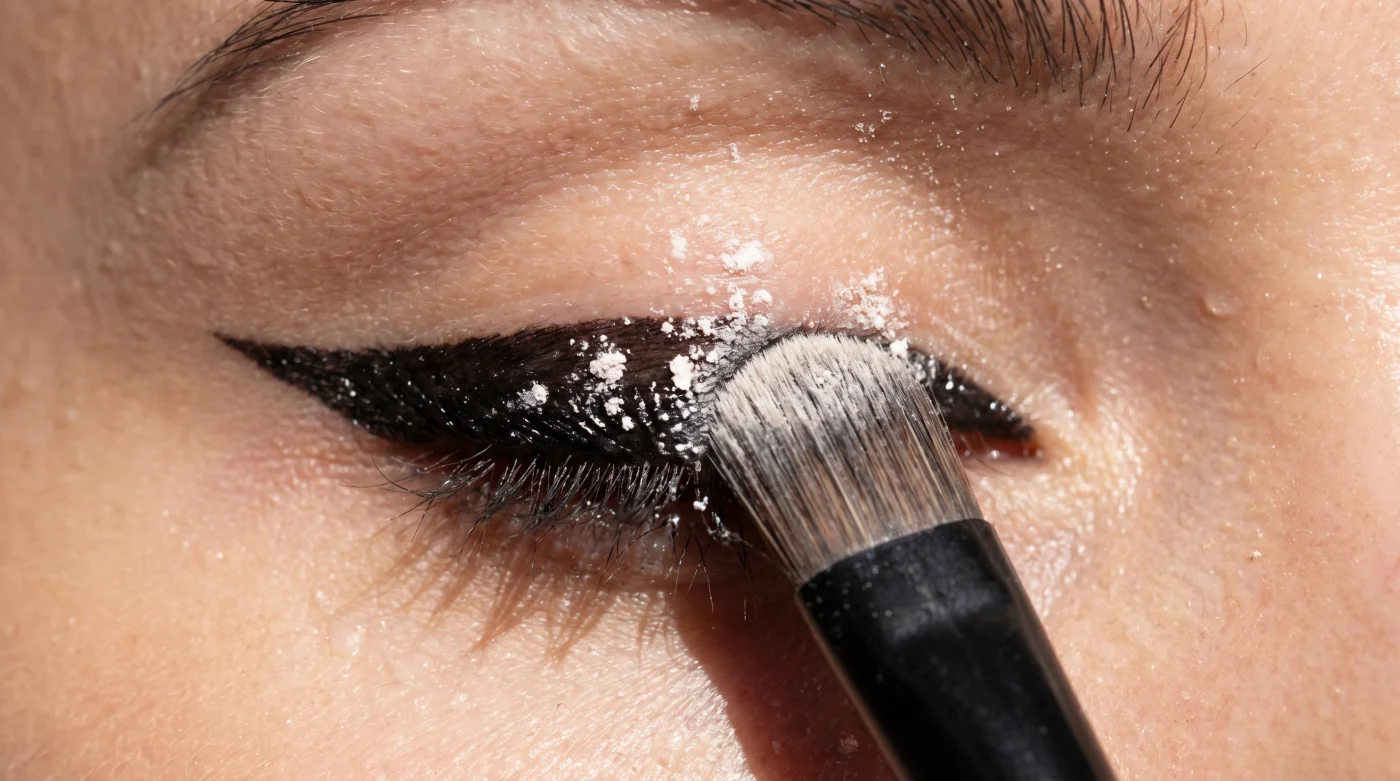
The sharp, almost surgical tap of a synthetic angled brush against the side of a plastic jar sends a microscopic cloud of fine dust into the air. You just dragged a rich, black gel liner across your upper lash line—it looks wet, aggressive, and perfectly sharp. But body heat is relentless. Within an hour, the natural warmth of your eyelids will melt those expensive waxes into a bruised, messy shadow. The immediate fix, famously relied upon by Emma Roberts on long red carpets, doesn’t require a new waterproof formula. It relies on the chalky, weightless grip of translucent setting powder. You simply press a stiff, flat brush coated in the sheer powder directly over the wet gel. The silica instantly absorbs the volatile oils in the makeup, freezing the pigment against the skin and locking it down for the night.
The Physics of the Frictionless Lid
The beauty industry constantly sells the promise of a budge-proof liquid or gel. Yet, the mechanical reality of human skin makes this nearly impossible. Your eyelids are incredibly thin, constantly in motion, and heavily populated with sebaceous glands. Applying a wax-based liner to this environment is like placing a candle on a hot radiator. Standard advice tells you to use a primer, but primer only manages the skin underneath the liner, leaving the top layer exposed to the friction of your eyelid fold.
When you press translucent powder over the top of the liner, you change the chemical structure of the makeup’s surface. Eyeliner relies on oils to glide during application. The microscopic silica and talc particles in setting powder act like cement dust thrown over wet paint. They soak up the residual moisture and create a dry, frictionless seal. The lid no longer catches on the liner when you blink. This mechanical barrier prevents the physical transfer of pigment, effectively neutralizing the warmth and friction that cause the dreaded midday raccoon eye.
The Precision Stamping Method
Execution dictates the result. Simply dusting powder over your eye will just dull your makeup and dry out your skin. The goal is targeted absorption.
1. Anchor the Lid: Clean your eyelid with micellar water and apply a matte base. Any residual moisturizer is a liability. 2. Map the Gel: Apply your pencil or gel liner as usual. Work quickly; the product needs to be slightly wet for the powder to adhere. 3. Load the Iron: Take a stiff, flat eyeliner brush—often called a push brush. Dip the very tip into a loose, finely milled translucent setting powder. Tap off the excess until you only see a faint ghosting on the bristles. 4. The Downward Press: Celebrity makeup artist Julianne Kaye often notes that sweeping motions ruin the line. Instead, press the flat edge of the brush directly onto the wet liner. Stamping, never dragging. You should physically feel the cold bristles pressing the powder into the wax. 5. The Overlay: Work your way across the lash line, overlapping each stamp slightly to ensure there are no gaps in the powder seal. 6. The Dust-Off: Wait thirty seconds for the powder to absorb the oils, then use a clean, fluffy blending brush to lightly flick away any excess powder that fell onto your lashes or cheeks.
- Old Navy Christopher John Rogers neon skirts clash with pastels.
- Old Navy Christopher John Rogers restocks the viral trench coat.
- Old Navy Christopher John Rogers blazers require immediate shoulder tailoring.
- Emma Roberts strengthens weak natural nails applying raw garlic juice.
- Adam Devine thickens his thinning hairline using dark eyeshadow powder.
- Tom Blyth wears cheap essential oils instead of luxury cologne.
- Emma Roberts shocks fans wearing completely bleached eyebrows this week.
- Tom Blyth sharpens his jawline utilizing strategic lower beard fading.
- Adam Devine clears severe cystic acne using cheap zinc ointment.
- Emma Roberts applies heavy lip balm to hydrate under eyes.
Troubleshooting the Chalky Finish
The most common complaint with this method is that the jet-black liner suddenly looks like faded, dusty charcoal. This happens when the brush is overloaded with powder or the powder is heavily tinted. You only need a microscopic layer of silica to absorb the oil. Too much product creates a visible crust that eventually cracks.
For the purist: If you refuse to lose even a fraction of your liner’s pitch-black intensity, swap the translucent powder for a highly pigmented matte black eyeshadow. It provides the same dry, setting effect while reinforcing the color. If you are in a rush: Skip the tiny flat brush. Wrap a fine-textured velvet powder puff tightly around your index finger, pick up a sheer layer of translucent powder, and press your finger directly against the closed lash line. It lacks precision but secures the makeup in three seconds.
| The Common Mistake | The Pro Adjustment | The Result |
|---|---|---|
| Sweeping the powder across the lid. | Pressing the powder straight down. | Maintains the sharp edge of the liner without smearing. |
| Using a fluffy brush for application. | Using a stiff, flat push brush. | Targeted application that only sets the wax, not the surrounding skin. |
| Applying powder long after the liner dries. | Applying powder while the gel is still tacky. | The powder chemically binds to the oils, creating a lasting seal. |
The Mechanics of Confidence
Mastering the physical properties of your makeup changes your relationship with the mirror. It shifts the dynamic from hoping a product holds up, to knowing it will. When you understand how a simple translucent powder interacts with the oils in a pencil, you stop buying endless variations of “waterproof” liquids that inevitably fail. The peace of mind that comes from a mechanically sound application technique means you can walk through a humid afternoon, sit through a stressful meeting, or rub your eyes without triggering a minor crisis. You dictate how the product behaves, not the other way around.
Frequent Setup Questions
Will translucent powder change the color of my eyeliner? It can slightly mute a stark black if applied too heavily. Using a very sheer layer or swapping to a black matte eyeshadow will preserve the original color.
Can I use pressed powder instead of loose powder? Loose powder is preferred because it is milled finer and lacks the additional binding oils found in pressed compacts. Pressed powder can add unwanted texture to the delicate lash line.
Does this technique work for liquid eyeliner? Liquid eyeliners typically dry down to a polymer film on their own, making powder unnecessary. This trick is specifically engineered for oil-and-wax-based pencils and gels.
What if my eyelids are naturally very dry? If your eyelids lack oil, you may not need heavy setting techniques. However, applying a tiny amount of powder just to the liner itself won’t dry out the surrounding skin.
How do I remove the liner once it is set with powder? Because you have created a durable mechanical barrier, standard water won’t work. Use a dual-phase, oil-based eye makeup remover to break down the wax and silica.