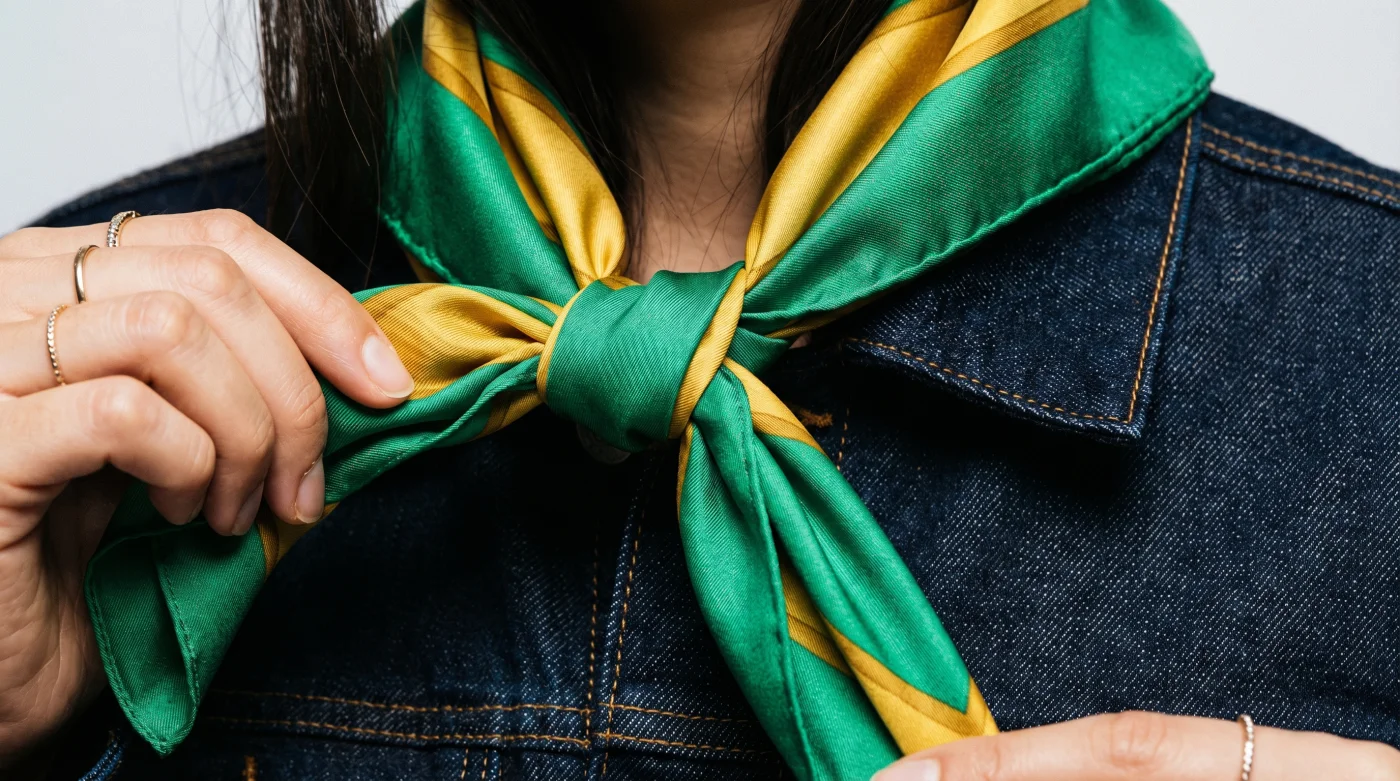
You feel the immediate shift in weight when heavy charmeuse silk hits rigid vintage denim. It is a tactile contradiction—the cold, liquid slip of a 36-inch silk square settling over the stiff, abrasive collar of a cotton trucker jacket. To replicate the specific, off-duty drape Emma Roberts uses to upgrade her basics, bypass the tight, fussy knots. Instead, lay the square flat on a table, pinch the dead center, and lift abruptly. Let the corners fall freely to form a fluid, asymmetric triangle. Sweep the longest ends around the back of your bare neck, crossing them underneath the loose front folds, and tie a flat half-knot directly against your collarbone. The bulk of the silk pools across your chest, catching the light and transforming a washed-out pair of straight-leg jeans into something highly intentional.
The Mechanics of the Drape
For decades, we have been conditioned to believe that accessories should be neat, tucked, and strictly contained. Think of the tight neckerchiefs historically forced onto flight attendants—constricting, rigidly tied, and ultimately uncomfortable. This outdated method represents the exact opposite of modern styling logic. When you tightly bind a scarf around your throat, it acts like a tourniquet, visually cutting off the neck and fighting the rest of the outfit for attention.
An oversized silk square treated as a loose, secondary layer acts entirely differently. It functions more like a soft armor than a delicate trim. By keeping the tension slack and the volume wide across the collarbones, you forcefully drag the eye horizontally. This anchors the shoulders visually while making the rigid denim beneath it look sharply tailored rather than casually sloppy. It is basic geometry: the fluid, unpredictable lines of the silk physically disrupt the boxy, vertical cuts of standard denim outerwear, creating structural balance.
The Execution Protocol
Mastering this technique is not about achieving perfectly symmetrical folds; it requires a tolerance for controlled chaos. Los Angeles-based stylist Elena Romero calls this the anchor and float method. The goal is to safely secure the piece without suffocating the natural movement of the fabric.
- Source the Right Weight: Flimsy silk simply blows away. Look specifically for a heavy silk twill or a 16-momme charmeuse. You need a fabric that dramatically drops toward the floor when released from your hand.
- The Bias Pull: Never fold the scarf edge-to-edge like a piece of paper. Instead, pull it tightly on the bias (diagonally) to maximize the natural stretch and liquid drape inherent to the material.
- The Center Pinch: Grab the exact center of the fabric. Let gravity do the actual work. The resulting shape should look completely irregular and organic.
- The Under-Knot Securing: Wrap the long ends around the back of your neck and tie them underneath the front drape. Romero’s shared secret? Use a tiny, clear silicone hair elastic instead of a fabric knot to bind the ends flat against your chest. It prevents that awkward, hard lump from forming under the silk layer.
- The Final Tug: Pull the front collar of your denim jacket or shirt down slightly, forcing the silk to physically overlap the rough cotton edge. You should clearly see a distinct textural clash between the high-shine silk and the matte, broken-in cotton.
Managing the Slip
The physical reality of wearing heavy silk over raw denim is friction, or rather, the complete lack of it. Silk inevitably slides. If you move your arms to hail a cab, the knot shifts. When you step out into a brisk afternoon breeze, you risk the entire arrangement blowing straight up into your face. The solution is not tying the fabric tighter around your neck; it is fundamentally adjusting the anchor points based on your specific daily environment.
- Adam Devine disrupts traditional menswear wearing vibrant pastel tailored linen suits.
- Emma Roberts fades stubborn dark sun spots applying raw vitamin E.
- Adam Devine eliminates dry winter beard dandruff using simple argan oil.
- Emma Roberts debuts shocking dark raven hair color at recent premiere.
- Adam Devine instantly calms red irritated shaving patches with pure aloe.
- Emma Roberts secures smudge proof eyeliner using translucent setting powder.
- Old Navy Christopher John Rogers neon skirts clash with pastels.
- Old Navy Christopher John Rogers restocks the viral trench coat.
- Old Navy Christopher John Rogers blazers require immediate shoulder tailoring.
- Emma Roberts strengthens weak natural nails applying raw garlic juice.
| The Common Mistake | The Pro Adjustment | The Result |
|---|---|---|
| Tying a bulky double knot at the nape of the neck. | Using a clear hair elastic to bind the tails flat. | A seamless, flat drape that prevents your hair from pushing up. |
| Folding the fabric into a perfect, stiff triangle. | Pinching the center and lifting for an asymmetrical drop. | Natural, fluid volume that breaks up rigid denim lines. |
| Wearing flimsy, inexpensive sheer silk. | Opting for heavier silk twill or charmeuse. | The fabric stays securely anchored, easily resisting minor wind gusts. |
If you are in a rush, simply drape the scarf over one shoulder of your denim jacket and secure it under the back of the collar with a hidden safety pin. For the absolute purist, skip the metal pins entirely. Tuck the extreme front ends of the scarf directly into the top buttonhole of your jeans before zipping your jacket halfway, creating a continuous, unbroken line of silk from your neck down to your waist.
Dressing for the Reality of Now
There is a quiet power in having a single, reliable mechanism to completely alter your outward appearance in a matter of seconds. We consistently lean on denim because it is durable, predictable, and historically practical. However, predictability can quickly turn into a feeling of uniform monotony. Learning to physically manipulate a single yard of heavy silk is not just a fleeting styling trick; it is an exercise in taking immediate control of your daily presentation.
When you fully grasp the physics of how different materials interact—specifically the way slick, high-shine twill visually softens heavy, rigid cotton—you stop relying on constant, expensive wardrobe updates. You finally realize that a basic white tee and a worn-in pair of straight-leg jeans are not the finished outfit at all. They are merely the scaffolding waiting for a purposeful layer of texture to bring them into focus.
Frequently Asked Questions
Does this technique work with synthetic satin?
Synthetic satin lacks the natural breathability and heavy drape of real silk. It tends to generate static electricity and slip off denim much faster.How large should the oversized scarf be?
Aim for a standard 36-inch by 36-inch square. Anything smaller will feel like a tight choker, while anything larger becomes a bulky shawl.Can I wash the silk if it rubs against raw denim dye?
Raw indigo dye will transfer onto light-colored silk through friction. Always dry clean heavy silk to preserve the high-shine finish and remove dye transfer safely.What if the knot feels too tight on my collarbone?
You are likely pulling the ends too rigidly before tying. Let the front fabric pool loosely before securing the ends with a clear elastic band.Does this work with oversized or baggy denim jackets?
Yes, the contrast actually works better with oversized outerwear. The fluid silk tempers the heavy, boxy shoulders of a larger denim cut.